#Pastrana

Plan Colombia: A success?

farc

Plan Colombia has seen the United States provide approximately $8 billion worth of aid to Colombia since 2000.

Over the course of three articles I will look at how (and the what extent) Plan Colombia has worked to strengthen democracy, combat the Revolutionary Armed Forces of Colombia (FARC), and in this first piece, reduce  coca cultivation and trafficking.

When President Pastrana presented Washington the original version of Plan Colombia in 1999, the Colombian state was at a breaking point. The internal conflict had pushed the economy into crisis with the unemployment rate at a staggeringly high 18.2% and GDP retreating by 4.2%. The worst figures this side of the Great Depression.

Pastrana saw Plan Colombia as a way of reviving Colombia and issues such as coca cultivation were secondary concerns that would resolve themselves after peace had been achieved. The American Congress however had a different idea and  reformed Plan Colombia into an anti narcotics initiative, focusing aid on reducing the production and trafficking of cocaine from Colombian fields into major American cities.

Has it worked?

There are inconsistencies between the figures the United States and the United Nations have on coca cultivation but it´s clear Plan Colombia has reduced cocaine production. The UN shows that in 1999, 680 tonnes of cocaine were produced in Colombia; by 2011 (the latest figures available) this had reduced almost 50 per cent, to 345 tonnes. The US reports even more favourable results, suggesting a reduction from 520 to 195 tonnes over the same period.

Despite these positive results, initial efforts to stem cocaine production were not so successful. When Plan Colombia began, aerial eradication campaigns saw over 380,000 hectares of coca fields fumigated between 2000 and 2003.

The strategy was successful in reducing the hectares of land cultivated with coca crops, yet it  failed to stem cocaine production throughout this period. In 2007 for example, after seven years of continuous spraying increases, the UN statistics showed that cocaine production had risen to 600 tonnes per annum.

Why? Colombian coca farmers played the game and knew how to compensate for the effects of the aerial eradication campaign – they reduced the size of their fields, made their plots harder to find, and increased their per hectare crop yield. In short, innovation delayed the success of aerial eradication.

Farmers were forced to innovate, as for many there was no viable economic alternative to coca production. Worse, the attempts to resolve these economics have been weak, and played second fiddle once Alvaro Uribe was elected in 2002. Uribe undeniably achieved great success using Plan Colombia in his fight against the FARC,  but his relentless focus on tackling the security issues meant economic development plans were something of an after thought. Military funding and action eclipsed efforts to resolve the socio-economic factors behind illicit crop production.

Positive inducement schemes were introduced by Alvaro Uribe however, and ran from 2005 -2009. The objective was to create jobs with economic potential for rural families in conflict prone areas.

Despite the USAID mission in Colombia reporting ‘significant progress’ through 2010, the scope of the success has been limited by both the (restricted) size of the programme and security concerns.

In 2008, the Government Accountability Office (GAO) found that the alternative development programmes were – unhelpfully – not located in areas where the majority of coca is grown. And US experts, Jason Spellberg and Morgan Kaplan argue coca farmers have not been taught how to generate wealth independently.

But production has reduced in more recent years

Yes; analysts attribute this to a switch in focus from aerial eradication campaigns to more intensive, manual eradication. This strategy is more effective than aerial fumigation as it both kills the plant directly, and has the knock on effect of building a more significant government presence on the ground.

Risks, are however, higher as the military are more exposed. FARC and ELN guerrillas work to sabotage efforts, routinely laying mines and IED’s in coca fields. Such dangers may explain why manual eradication has been on a downward trend since 2010, despite its proven success.

Production is also down because of the increase in the presence of the security forces and the fact the guerrilla groups have been pushed back from areas they once controlled.

Statistics compiled by the US and the UN suggest Plan Colombia has been effective in reducing the production and trafficking of cocaine. The discrepancy in figures between the two bodies  however, troubles us. To understand the full success a more transparent and detailed methodology for data collection is needed.

Of course Plan Colombia has other aims too…We´ll look at those over the coming days.

Photo, Open Briefing

Bojayá massacre, Uribe and Plan Colombia

IMAGEN-11677964-1

The massacre of Bojayá represented a low point in war in terms of mistreatment of the civilian population in Colombia, but its horror marks an important moment in the nation´s recent political history ocurring at a turning point in the battle against the FARC guerrillas.

Plan Colombia and elections

The genocide occurred in May 2002, while in February the then President, Andrés Pastrana Arango had called off the four year long peace talks with the FARC, citing a lack of political will on behalf of the guerrillas,

The tragic events in Bojayá occurred during an election campaign in which a fringe-candidate with a “mano dura”/hardline law-and-order agenda, Álvaro Uribe Vélez, emerged on the national stage. The massacre served as political fodder for the then candidate to further paint the FARC as genocidal narcoterrorists needing to be militarily defeated.

Uribe later won the 2002 elections in the first round/without needing a run-off, an historic first in Colombian politics. As President, Uribe (and Pastrana as well beforehand) used the genocide as part of a campaign to get the FARC on “terrorist” lists in the European Union, the United States, Canada and other countries so as to legitimate a military rather than a political solution to end the armed conflict.

Meanwhile, in 1999 Andrés Pastrana had negotiated with Bill Clinton a multi-billion dollar aid package which, although partially focusing on economic development, was mostly military aid. The deal, which was at first framed around fighting narcotrafficking and the War on Drugs was known as “Plan Colombia” and made Colombia the no. 2 recipient of US military aid in the world, behind Turkey.

Following the attacks of September 11th 2001, and after the genocide and the election of Uribe in 2002, the Plan Colombia money was used also to fight the FARC and was seen as a strange convergence between the interests of the War on Drugs and the War on Terror.

Plan Colombia politics were used to professionalize the army, leading to an historic high in military spending, known domestically as “Plan Patriota”/the Patriot Plan. This plan expanded the presence of the Army into the most marginal and peripheral areas of Colombia in order to fight the guerrillas. The knock on effect of this expansion was to  increase – rather than reduce – violence in the Chocó region in subsequent years.

As Plan Colombia was rolled out, concern grew within the State Department and the US Congress about links between the Colombian Army and the Paramilitary AUC who fought against the FARC.

Survivors´ voices ignored, or forgotten?

Uribe had been warned of the US distaste, and in response, as part of a “reparations” package, constructed ‘The New Bellavista’ (a new church and housing development). All this was done to a more modern and western style, totally foreign to the Afro-Colombian tradition of the local population. And strangely when inaugurating the “New Bellavista”, President Uribe gave his speech exclusively in English.

Many community members (whose language is of course Spanish), felt that the government was using Bellavista – as a community and a project to “show off” as part of its reparations agenda. An affront then, that it seemed as though the government was directing its initiatives to improving its international image and not the people who had actually been affected by the massacre.

Worse still, many of the economic aid projects established by the government and the NGOs were seen as unsustainable; creating dependency rather than development. All of the initiatives in ‘New Bellavista’ were considered by the displaced population in Quibdó to ignore their needs.

Last year, as the 10th anniversary of the massacre was marked, much attention was given to how the community still lacks a medical centre and other basic needs. This, despite the Constitutional Court having declared the community entitled to such investment as part of the reparation package. So, 11 years on and the community stills appears forgotten, the victims of the war not properly attended to, or represented.

There is, too, very little comfort to be taken from the way in which justice has been dealt. 36 members of the FARC-EP, including members of the Secretariat, have been involved in judicial processes concerning the massacre, but only 8 have been convicted. No charges have been brought before the AUC paramilitaries, and least of all now given the legal benefits afforded to them as part of their 2003-2006 demobilization.

Part three of this report will look at the challenges the community still faces, and offer a view for the future.

Simon is the owner of the website The Banana Plutocracy

Photo, El Tiempo.

Colombia mourns as ICJ hands Nicaragua Caribbean seas

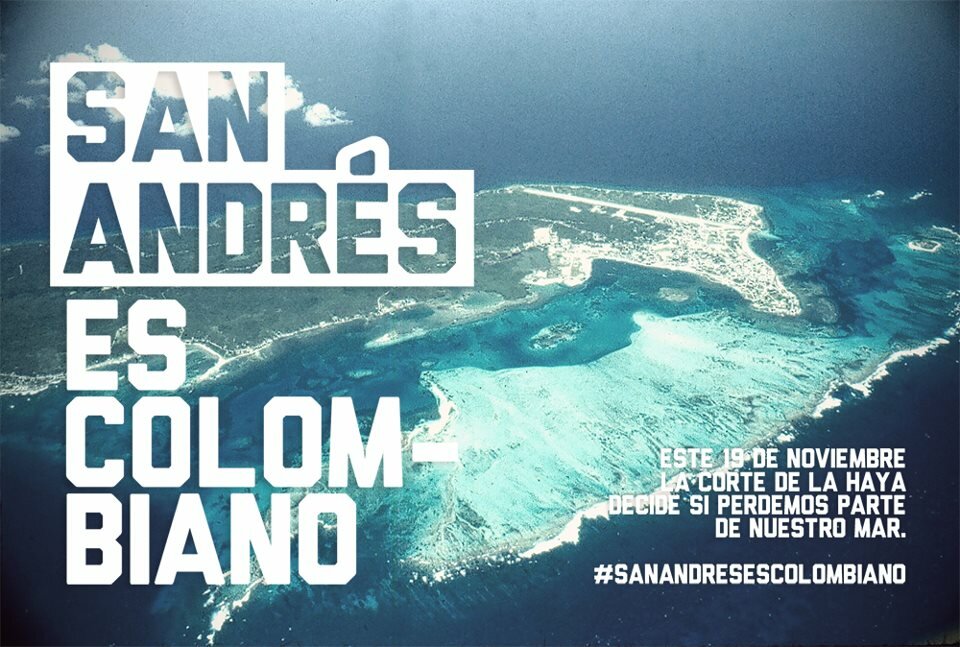
Colombia yesterday lost its battle to retain the Caribbean waters that surround the islands of the San Andrés archipelago following an unexpected ruling by International Court of Justice (ICJ) at the Hague.

The ICJ has handed Daniel Ortega´s Nicaragua sovereignty over important fishing routes and maritime territory expected to be rich in oil and gas.

The archipelago, part of Colombia for over 200 years, has long been the victim of Nicaraguan aggression and 11 years ago the Pastrana government accepted the jurisdiction of the ICJ to mediate in the dispute.

Pastrana´s decision today looks flawed. Why did Colombia submit itself to the whim of an international body? Would the British cede such control over the future of the Falklands?

So as Colombia licks her wounds of defeat and as Ortega corks the champagne, questions arise over the effectiveness of Colombia´s foreign policy.

María Ángela Holguín, the Foreign Minister faces calls for her resignation, but appears reluctant to do so. This morning she told the press that “if my resignation were to resolve the problem, well show me where to sign”. Nevertheless, Congress hopes to pass a motion of censure for the ministry´s failings.

In truth though, while Holguín will not look back on this moment as her finest hour, it is perhaps fairer to apportion the blame to the ministry itself. Years of ineffectual diplomacy has left Colombia isolated. Where are her allies jumping to her defence, where are the allies expressing outrage at the decision? Where was the international pressure before the court´s decision?

President Santos last night spoke to the nation to express his opposition to the court´s decision. The government must now examine what to do. There is no legal avenue open to them, no recourse to appeal (unless an error is identified in the court´s decision making process – a highly unlikely eventuality).

So what next? Refuse to go along with the court´s decision, or sit back and watch Ortega gloat?

High profile Liberal Party Senator Juan Manuel Galán tweeted the following:

“It now falls to the Congress to execute the court´s decision by modifying the constitution. I will vote against this amendment.”

The political fallout and the cost to the Santos regime is only just beginning to play out. The debates in Congress will be fierce. Last night on the top radio programme Hora 20, former Senate President Armando Benedetti in indignation also promised to stand firm against the decision:

“I´m calling for us not to recognise the court´s decision because it isolates and ghettoizes San Andrés. What we did (by allowing it go to the ICJ) was of the utmost stupidity.”

Holguín has bought the government a bit of time, promising to explore all the options open to it. To many, though there are precious few ways out of this mess.

The San Andrés islanders will now fear the worst. Daniel Ortega offered a reassurance to the fisherman that they will not be met with aggression, but his words are hollow in the extreme. The routes are now open to the pirates and narcotraffickers that patrol the area, and Ortega has neither the inclination or the power to do anything about it.

The map below shows the new Nicaragua Colombia border, revealing just how cut off and boxed in the islands now are.

Perhaps the eloquent lament of the top San Andrés politician Representative Jack Hosni, when interviewed on Blu Radio this morning, tells us all:

“San Andrés is now the only archipelago in the world without a sea”.


Boxed in and cut adrift. Photo, El Tiempo

La larga crisis del Partido Conservador Colombiano

Expresidente Pastrana, foto El Espectador

Guest article by Miguel Benito Lázaro.

Les voy a dar una noticia que no sorprenderá a nadie: el Partido Conservador Colombiano está en crisis. De hecho, vive en una crisis permanente y cotidiana. Y el problema radica  en que ya nadie se sorprende por ello.

Una crisis que nació al final de la presidencia de Andrés Pastrana, cuya impopularidad se extendió a todo el partido, dejando el campo abierto para que Álvaro Uribe, una vez en el poder, pudiese atraer a buena parte del liderazgo conservador -y también del liberalismo-. De esta manera, por el desprestigio del partido y por la migración de algunos de sus notables, Uribe asumió las banderas tradicionales del partido sin resistencia. De ese modo el conservadurismo se quedó sin identidad ante la opinión pública.

Y los conservadores parecen haberse acostumbrado a ese estado de cosas que les deja como un partido sin posibilidades reales de conseguir la presidencia de la República, constreñido en feudos rurales y algunas ciudades medianas, pero sin acceso a las grandes urbes, y con un discurso totalmente ajeno a las preocupaciones de la mayoría de los colombianos que acentúa la creciente marginalidad del partido conservador.

Pero lejos de aceptar esta realidad, el conservatismo se engaña y cree que aún mantiene una gran representación popular, porque se ha convertido en una maquinaria orientada a conseguir cuotas de poder, vía acuerdos burocráticos y componendas interpartidarias, que no necesitan de apoyo popular. El mayor exponente del burocratismo.

La crisis está siendo tan devastadora que el expresidente Pastrana -el peor valorado de los presidentes recientes de Colombia y cuya impopularidad personal está en las bases mismas de esta crisis- puede presentarse hoy como la opción de modernización y dinamización del colectivo y que no parezca una idea descabellada. Porque el partido ha entrado en una regresión ideológica fundamental.

En el último año y medio Liliana Rendón, Juan Manuel Corzo y Enrique Gómez Hurtado gozaron de alguna notoriedad pública. ¿Por alguna importante propuesta política? No. Hace mucho que el Partido Conservador no lanza iniciativas de interés y alcance. La única plataforma que se le conoce actualmente tiene que ver más con la religión que con la política, intentando regular más y de acuerdo a postulados religiosos y valores sociales tradicionales comportamientos privados. Conservadores en pro de mayor regulación y chocando directamente con el principio de laicidad del Estado. Una auténtica traición a los fundamentos filosóficos del conservadurismo.

Todo esto sería superable si el Partido se abriese a sus bases y las empoderase mediante mecanismos de democracia interna -como había venido intentando en años anteriores- pero en una muestra más la incapacidad para leer tendencias y aprovechar oportunidades la dirección conservadora ha preferido restringir las decisiones a “los notables”, una auténtica oligarquía, cuyo único interés es mantener el control sobre el partido y por cuyas cabezas la idea de reforma, adaptación y modernización suena extraña y peligrosa.

Con todos estos elementos nos asomamos a un desolador espectro de Partido Conservador Colombiano sin liderazgo nacional, regionalizado, sin proyecto de país ni propuestas que conecten con el ciudadano. Esta es la realidad de la larga crisis del conservatismo colombiano de la que nadie habla y que la dirección nacional negara mientras siga entrando en los repartos de cargos.

En definitiva, malos tiempos para ser conservador en Colombia.

Miguel Benito Lázaro es analista político, docente de la Universidad de Externado de Colombia en relaciones internacionales, y panelista invitado de diferentes programas de opinión nacionales.

Esta columna fue publicada inicialmente en la Revista Posición.

President Juan Manuel Santos, a political biography

President Santos, photo, AP


Juan Manuel Santos was destined to become President of the Republic.

In August 1951, Juan Manuel was born into one of Colombia´s most powerful families; his father, Enrique the owner (at that time) of the most important newspaper El Tiempo, and his uncle Eduardo, a former president.

From an early age, Santos moved in political circles, allowing him to master his famous ability to strategize and outsmart the acutest of opponents.

As extra-ordinary as it sounds, Santos´ first test at the ballot box was that of the presidential elections in 2010.

Until then he had not actively had to win a public vote, instead beating his opponents behind the scenes, in the corridors of power; these were victories among colleagues and eventual bosses, not on the election battleground.

Santos´ is a chess player who keeps his cards close to his chest.

Aged 16, Santos embarked on two years of military service as a Navy cadet, helping to forge his famous and steely discipline. On completing his time in the armed forced, Santos, like most youngsters from the Bogotá elite, left Colombia for the United States, where he entered the University of Kansas to read economics and business administration.

The next stop was England and the London School of Economics for a master´s, before landing a job with the National Federation of Coffee Growers where he worked for nine years and began his diplomatic career.

Santos eventually returned to Colombia to take up a role in the family newspaper, El Tiempo, a position he held until 1991 when President Cesar Gaviria gave him his first job in government, as minister for the newly created department of Foreign Trade.

Gaviria´s government set about the liberalization – and the internationalization – of the Colombian economy; with Santos´ ministry at the forefront of this agenda.  Santos is responsible for signing Colombia´s first free trade agreements – with Mexico and Venezuela – a trade philosophy he has placed at the heart of his own government´s foreign policy.

Santos´ career then went stratospheric when anointed the ´Designado de la República´, a position (now defunct) without portfolio (similar to the vice-presidency), but with power and political influence, allowing him to establish, among colleagues, a profile as a potential future president.

Santos left the government 1994, when Ernesto Samper came to power and formed the Good Government Foundation think tank, a platform from which he would plot his entrance to the Casa de Nariño.

The think tank was aligned to the thinking of the ´Third Way´ the philosophy on which Britain’s Tony Blair came to power in 1997, and many of the key members of this group entered the cabinet when Santos became president in 2010.

Santos then experienced first-hand the ill-fated Pastrana / FARC peace talks in Caguán, when sent by the international community to oversee the implementation of the Demilitarized Zone the talks had created.

Santos lost faith in the mission and became a harsh critic of the Pastrana government until he was appointed Minister of Finance in 2000.

When his future boss, Álvaro Uribe came to power Santos was still a member of the Liberals. But by 2005, he had formed the U Party to support the reelection of Uribe.

Then came Santos´ finest chess move. Having built a coalition of support for Uribe and having delivered the president a congress at his whim, Santos was in a position to demand of his boss any role in government. He opted for the Ministry of Defence, which he took up in July 2006. This was the most important job in an administration that placed Democratic Security at the heart of it mission.

Santos became Uribe´s right hand man.

As Defence Minister, Santos delivered major blows against the FARC, dismantled numerous rebel fronts, took out one the group´s top leaders, Raul Reyes, and successfully executed Operation Jaque, which led to the rescue of Ingrid Betancourt and three American hostages without a bullet being fired.

Santos´ public profile was assured, and his fight for the presidency gathered pace.

The ´false positives´ scandal – in which civilians were killed at the hands of the military and presented as guerrillas fallen in combat threatened to derail his plans, but no responsibility for these acts was laid at the door of the ministry.

Santos is credited in fact with uncovering and ending the practice.

At 2010 approached, Uribe sought a further re-election but was prevented from doing so by the courts, clearing the way for a successor to be anointed.

Santos eventually emerged as Uribe´s chosen candidate and ran for the presidency on the U Party platform.

In the second-round runoff, Santos beat Green Party candidate, Antanas Mockus, securing ten million votes, the highest vote in the country’s history.

In his acceptance speech, Santos dedicated his victory to Uribe, having promised throughout the campaign to continue the president´s legacy.

As soon as Santos entered power, he changed the mantra from Democratic Security to Democratic Prosperity, continuing the military attacks on the guerrillas, but also placing economic growth at the heart of his government.

A national unity government was formed, and over 90% of the Congress was placed at the new president´s disposition.  Santos was, in parliamentary terms, even more powerful than Uribe had been.

The first two years of Santos´ rule were characterized by legislative hyperactivity, with major reforms pushed through Congress.

Santos has presided over continued economic growth, reduced poverty and unemployment and dramatically changed diplomatic relations with neighbouring countries.

All the while, the war against the FARC has not relented.  Within months of taking office, the FARC´s military chief ´Mono Jojoy´ was killed and last year the overall leader of the guerrilla group, ´Alfonso Cano´ was also taken down.

During his time in office Santos has enjoyed record levels of support from Colombians, for certain periods, even eclipsing Uribe in the public´s approval. Towards the end of his first two years the polls turned and the president began to see support hemorrhaging amid a series of parliamentary crises and an upsurge in FARC activity.

In August Santos announced that secret talks with the FARC had led to agreement on an agenda for official peace negotiations. The talks seek to put an end to nearly fifty years of civil conflict.

The polls have returned in Santos´favour and should he sign an agreement with the FARC for a permanent cessation of violence, the president will have virtually guaranteed his re-election in 2014 (should he chose to stand).

For those who know Santos, however, it is a place in history as the president who secured peace that is, for the president, the real prize.

Santos has always had power, he was born into it. An historic legacy, however, is something he will have had to earn.

Dare we dream of peace in Colombia?

Colombian President Juan Manuel Santos confirmed Monday evening that his government has entered into exploratory talks with the FARC to negotiate an end to 50 years of conflict.

Earlier in the day Venezuelan television channel Telesur reported that both sides had signed an agreement to advance official peace negotiations scheduled for 5 October, in Oslo; details Santos refused to confirm.

The president has received support from across the political spectrum and in the country’s media. Ex-president Alvaro Uribe, however has denounced his successor as a traitor and an appeaser.After ex-President Pastrana’s failed attempt to secure peace over a decade ago, and following a recent upsurge in FARC activity, there are also parts of Colombian society sceptical of Santos’ ability to end the continent’s longest-running civil war.

Dare we dream of a Colombia in peace?

Talking behind closed doors.

President Santos has promised in the coming days to reveal the details of the 30 meetings held in private between his government and the FARC over recent months in Cuba. What we know is that Enrique Santos, the president’s brother led the delegation, and that representatives of the Chávez and Castro regimes were present. We also understand agreement was reached on the agenda for talks, the issues for negotiation and potentially the red-lines.


Crucially, it is reported that the facilitators were able to establish a level of trust between the terrorist group and the government (evidenced by the FARC’s decision to maintain silence throughout the day and wait for the President to speak) – essential if peace talks are to be successful.

Santos has received severe criticism from Uribe and his followers – both for entering into discussion while bombs explode and battles rage, and for doing so clandestinely.

But Uribe is not the only source of opposition, there are sections of society highly critical of Santos’ approaches to the guerrilla group. They point to the level of violence evident in different regions of the country and argue that the FARC are not ready to negotiate.

They might have a point, but analysing the situation differently it is easy to see that the FARC’s recent actions are a sign of desperation, a last-ditch attempt to improve their position at the negotiating table.

Neverthless it will be difficult for President Santos to hold his coalition and the nation together throughout  a peace process whose timescales are unknown. The president has confirmed that the talks are not conditioned on a cease-fire, and will therefore run parallel with the battles, the deaths, the bombs and the political recriminations. The guerrillas will seek to prove they are still a viable fighting force, we must not allow them to convince us that they are.


How will the talks work?

President Santos made clear that the country had learnt the errors of the past. The infamous talks at El Caguan that broke down in 2002 have become a byword for the FARC’s duplicity. The rebel group ridiculed Pastrana’s government with broken promises that forced Colombians to lose all confidence in their political leaders. Uribe came to power on the back of the collapse in these talks, promising to punish the FARC.

Santos is a statesman that has studied closely this episode, and of course more successful negotiations across the world. He has previously sought help from former British Prime Minister, Tony Blair who masterminded the famous peace agreement in Northern Ireland.

He is also a president who has worked for decades to end the conflict. Even in 1997 when Santos was the Liberal’s pre-candidate for the presidential elections of 1998, he had a clear plan for peace. When Santos entered the presidential palace he placed the search for peace not only at the heart of his inauguration speech, but also his legislative agenda.

Santos is desperate for his legacy to be the president that delivered peace to Colombia.

As well as Santos’ abilities there are other reasons to be optimistic that the mistakes of the past will not be repeated. The most important is perhaps the change in dynamic between the government and the FARC. In 2002 the state was weak while the guerrillas were in the ascendancy.

There was no imperative for the FARC to negotiate or give up a struggle they had every chance of winning. Following Plan Colombia and the money invested during the Uribe years in fighting back the rebels, the Colombian state has emerged healthy and economically successful while the guerrillas are on their last legs.

Equally, the government is in a significantly better position to offer the FARC what they want. The transitional justice laws are in place that will permit a negotiated settlement for criminal punishments, and also lies open the way for political representation. Additionally, the Santos regime can point to the land restitution law which helps deliver a flagship FARC demand for rural community justice.

Finally, the Caguan peace talks were dominated by discussions about securing a cease-fire and a demilitarised zone. In Oslo this will not be on the agenda, permitting the focus to lie instead on the fundamental issues upon which a lasting peace can be established.

Speculation suggests that the talks will centre on the following issues:

  • Narco-Trafficking
  • Reintegration into civil society and political representation
  • Rural development
  • Human rights


Once Santos – in the coming days – starts to confirm the detail of the talks, it is hoped he will also reveal the names of the negotiators. It is speculated that ex-president Cesar Gaviria will lead the government team, with a significant international contingent including Hugo Chávez and Chilean President Piñera also expected to be present.
While there has been no word from the FARC, and questions remain about the ability of its top brass to speak with unity for the fractured organisation, Timochenko and Fabián Ramírez are tipped to participate.


So is peace in sight?


The conditions are not perfect, the FARC remain a force whose acts of atrocity have increased dramatically since the turn of the year. But the conditions will never be ideal, and it is clear that neither the government  nor the guerrillas have achieved their goals through military means.


By holding the talks in Oslo (famous for negotiated peace settlements between the Israelis and the Palestinians, the Tamil Tigers and the Sri Lankan government among others) in the presence of the international community, it will be difficult for either side to complain of bias or illegitimacy.


An unresolved question is how involved the Colombian people will become and how President Santos can keep them onside. There are rumours that the government have hosted a series of focus-groups across the country, to understand reaction to the guerrillas and to possible peace accords. Now the talks are in the open, the government cannot afford to risk losing popular support as it inevitably asks Colombians to swallow unpleasant concessions.


The Colombian government has a constitutional duty to seek peace and President Santos’ efforts must be supported. The FARC are a spent force whose leaders have spoken of their desire to bring the war to an end. They have fooled us before, but this time things might just be different.

Uribe will continue to attack but he should reflect that the advances in security made during his eight years in power have made today’s announcement possible. When Uribe entered office he spoke of his hope that the guerrilla would demobilise and that Colombia would have a ‘politics with arms’. It will be a long a painful journey, but the alternative is another decade of bombs, bullets, kidnappings and assassinations.

A Colombia in peace is the ‘country within reach of the children’ as Garcia Márquez put it.

Also published on Redes Colombia


Colombia’s ex-president Andrés Pastrana to stand for election in 2014?

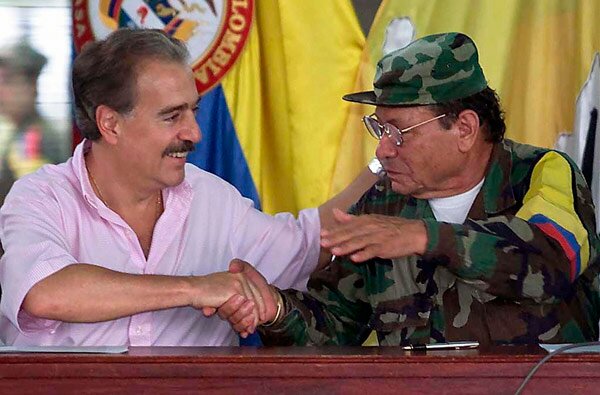
Pastrana and FARC Leader Marulanda en Caguán

Colombia awoke to the news this morning that Conservative ex-President Pastrana was to run for election in 2014. According to the radio station, La W, the ex-president had decided, over a decade after leaving office, to try again for the Casa de Nariño. 

Pastrana’s campaign was said to be based on the fight to secure peace, an ironic twist for critics who remember him as an unpopular president whose mandate had been tarnished by his failed attempts to deliver peace through negotiation talks with the ELN and the FARC.

Those who view Pastrana more favourably point to the legacy he secured through the signature of the Plan Colombia, a treaty with the US that led to millions of dollars of aid to fight the FARC. This money allowed President Uribe to deliver his ‘Democratic Security’ strategy that pushed back the guerrillas and helped the president establish his reputation as the man who saved the country from the communist threat.
Pastrana’s tilt for the presidency was also understood to be based on his dismay at the direction his party is heading. Pastrana strongly criticised the previous Conservative leadership for what he saw as a  moral bankruptcy and an erroneous policy platform. It was, however, hoped that he would return to fold following the installation of Efraín Cepeda as party director at the end of last year. Cepeda is a protegé of Pastrana and his politics are closer to those of the ex-president than were those of the previous leader, Salazar.
While Pastrana has been less outspoken, he is understood to remain concerned about the Conservatives’ role on the national stage. The party is within President Santos’ coalition government, but they complain about a lack of influence on the president’s policy decisions. Ahead of the start of this congressional session (in July), Cepeda put Santos on notice that the party was considering its position within the government, and that it demanded both a change the president’s politics and the replacement of two cabinet ministers (implicitly moving two Conservatives into the vacated seats).
Santos is yet fully to react to Cepeda’s demands, and there are rumours that members of the party close to  Uribe are agitating to join the ex-president’s new political movement, Puro Centro Democrático. The party threatens to split with former leader and arch-Uribista Salazar perhaps heading up the group of ‘defectors’.
Pastrana is anti-Uribista and fears the party is about to lurch to the mano dura rightism of his successor as head of state. But for Pastrana the thought of the Conservatives remaining (long-term) with Santos offers precious little more in the way of comfort.
Should the party remain with the president (or align with Uribe) and choose not to launch its own presidential candidate in 2014, Pastrana fears a continued decline in the influence of Conservatism. After the unsuccessful presidential candidature of Noemi Sanin in 2010, and the disastrous showing at the local and regional votes in 2011, the relevance of the party as an electoral force is in doubt.
Pastrana is desperate to arrest this decline – the Conservatives, until the emergence of Uribe in 2002, formed part of a two-party state in which power alternated between them and the Liberal Party. It now threatens to be relegated to an also-ran.
Amid the uncertainty about the movement’s plans for 2014, the ex-president appeared this morning to be taking matters into his own hands, announcing that, yes, there would be a candidate – and that it would belong to the centrist wing.
No sooner had the La W aired its exclusive and Twitter – fast becoming the platform of choice for political debate in Colombia (with the lack of argument on the country’s traditional media) – fizzed with a mixture of shock and incredulity. Was Pastrana serious? Surely he had been off the stage too long and was too old? As for his attempt to position himself as the candidate of peace when he failed when last in office…
Judging by the reaction on Twitter – and given the Uribistas appear to outnumber the rest by a significant margin on this medium, it isn’t a fair reflection of the national mood – Pastrana’s election campaign would be doomed, defeat assured.
By mid-afternoon, however, this near certain ignominious end was avoided and the shortest candidature in history was over. Pastrana emerged to announce that La W had got the wrong end of the stick – he was withdrawing his name before it went forward.
So was the La W just making it up?
While the radio station might have misinterpreted the signals, there is an underlying political truth that Pastranism (if not Pastrana himself) is positioning itself for a move within Conservatism.
At the end of last year before Cepeda took over the leadership, party bigwigs began to coalesce around the possibility of a Pastrana return as CEO. Cepeda was seen as the candidate to unite both wings, keeping the Pastranistas onside. The news today suggests that the level of discontent is rising. Pastrana’s non-candidature is a form of threat, a cry to be heard and start of a crucial period for Conservatism.  The party must decide its future direction ahead of next year and the start of the painfully long pre-election period.

Also published on Redes Colombia

Colombian Conservatives place President Santos on notice

Senator Cepeda, Conservative Leader, photo, Semana

As the curtain raised on a new session of congress on Friday, Efraín Cepeda, the director of the Colombian Conservatives, warned of a ‘crisis’ in President Juan Manuel Santos’ National Unity coalition government.
The leader of the second largest parliamentary force was speaking after a special meeting of his troops where their presence in this coalition was confirmed, but where it was also conditioned on big change.
Cepeda is exploiting the first serious signs of weakness in the Santos regime; the president is desperate to restore relations with congress, and is starting to look over his shoulder as Alvaro Uribe’s political party takes shape. 
Many Conservatives are ideologically tied to Alvaro Uribe rather than President Santos and will be tempted, as we approach the pre-election cycle next year, to join his movement. For Santos the price of their continued support has risen significantly. 
The Conservatives’ march towards unity?
Efraín Cepeda was sworn in as president of the Conservatives at the end of last November taking over from José Darío Salázar. Salázar left the parted divided; those on the centre were left cold by the socially right-wing campaigns of 2011 (against gay-marriage and abortion). Andrés Pastrana, the last Conservative president (1998-2002), spent much of the year attacking the party for its policy direction and its supine attempts to weed out corruption within the collective. 
Although Cepeda arrived in parliament on the coat-tails of Pastrana, he has allies on both wings of the party and was seen as a unity candidate, bringing the Pastranistas and Uribistas together. His job of keeping his colleagues batting for the same team has been made more difficult, however, by the emergence of Alvaro Uribe’s Puro Centro Democrático. The stakes are now higher and should he fail, many Conservatives could jump ship. A further complication is that Former Defence Minister and leading Conservative (although also previously a member of the U) Marta Lucía Ramírez is even talked about as a possible Uribista presidential candidate. Under such circumstances the gravitation pull towards Uribe could become a force impossible for some to resist. 
To keep the Conservatives together, Cepeda must secure more goodies from the president. The parliamentary party will be less inclined to leave the coalition if they are tied in by grace and favour and if they feel their voice is heard more in the decision-making process.
Santos / congress relations a Conservative opportunity?

Congress feels scapegoated by the president. Santos only weeks ago forced his coalition partners to vote down the controversial Justice Reform bill days after he had whipped them to vote it through. Public anger at the legislation led to pillorying of parliamentarians; accused en masse of corruption and self-interest.

The parliamentarians’ resentment arises from the feeling that Santos pushed much of the blame onto them instead of accepting the government’s role in the fiasco – after all the government proposed the legislation, they argue. This discontent was evident as Interior Minister Federico Renjifo stood up to speak during the vote to ditch the JR bill – in an unprecedented reaction from congress toward a minister of state, Dr Renjifo was whistled at and boo-ed.

Reaction to JR bill led to a strategic rethink from Santos. At a special cabinet meeting to determine a way forward – called earlier this month – Santos told colleagues that he was focused more on public opinion than on securing harmonious relations with the law-makers. The Santos administration is, however a reforming government that needs the security or the ‘governability’ (the president confesses this is his favourite word) of the National Unity coalition. It is little surprise then that ahead of the start of the new parliamentary year (the third, and penultimate in Santos’ first mandate), diplomacy between the presidential palace and its legislative partners went into overdrive.

Efraín Cepeda is taking advantage of this situation. Under Salázar, the Conservatives were the opposition within the coalition. The party’s old boss is an arch-Uribista and was one of the first politicians to criticise Santos for departing from the ex-president’s Democractic Security doctrine.

When Cepeda took over efforts were made to repair the relationship. In February, the new leader was one of the first out of the blocks to defend the Santos regime when news emerged of the exiled Luis Carlos Restrepo’s attempted political coup to prevent the president’s re-election. The Conservatives were ‘proud to support the government’, Cepeda confirmed.

The cost of coalition politics

The Conservatives are calling in their chips, but how do they want Santos to pay? Effectively it comes down to do things – personnel and policy, and the Conservatives want Santos to show more leg on both.

Something the president needs to resolve quickly is Cepeda’s assertion that there are ‘useless ministers’ in the cabinet, a ‘crisis’ at the heart of the government. Cepeda has attacked the ministers for education and for health – both for their abilities and politics.  In doing this, Cepeda has announced that his Conservative party is moving to occupy this key social policy territory. He will want Santos to recognise this by moving Conservatives to these positions. 

This is smart politics. The tactic is to position the Conservatives not as the party of pro-life anti-gay hardliners but instead a modern political movement focused on removing the social barriers to success, to reducing poverty and to increasing opportunity.

It is also a move that understands where the public mood is starting to turn. The government has faced criticism for its education policies (particularly its university reform proposals which were shelved due to public protest), and its inability to resolve the health crisis which many highlight as political ticking time-bomb about to explode. Should Conservative ministers arrive in these positions and offer an alternative, a way out of the mess, then the party will be well positioned as the country moves into pre-election mode next year.

The Conservatives want high-profile ministers in high-profile roles and they want Santos to start to deliver Conservative policies. As senate spokesman Hernán Andrade warning Santos – the relationship must be ‘reciprocal’ between the party and the government.

This website has reported before on the disquiet within Conservative ranks (recorded early on in Santos’ regime) at the direction the government is heading. The feeling has been that Santos has been suspiciously minded towards Liberal Party policies – and indeed Liberal politicians. Under Salázar in particular, the Conservatives felt marginalised, an afterthought in the coalition. Cepeda’s move on Friday seeks to use the game-changing events of the Justice Reform bill to ensure that a more Conservative looking agenda is pursued by the Casa de Nariño. Cepeda has given the president a choice, he has told him to demonstrate that the Conservatives have a role to play or to expect their eventual opposition to his government. From the sidelines Uribe will attentively await Santos’ answer.

Also published on Redes Colombia