#Peace

FARC peace accords signed by 22 February

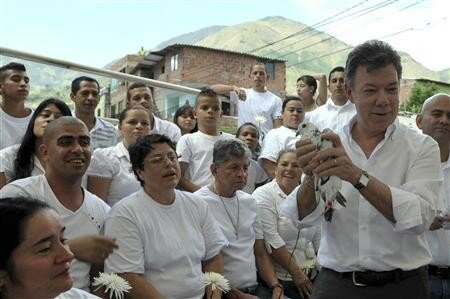
Peace with the FARC guerrillas must be signed by 22 February to be put to a referendum on 25 October; the day of Colombia’s local and regional elections.

Colombia’s Constitutional Court has ruled that President Santos must present any peace agreement with the Marxist rebels to Congress no later than 24 February, and that the public must be told in advance of this date.

Read more…

Vote for peace, vote for Santos?

santoscampaña

If Colombia’s President Juan Manuel Santos has his way May’s election will be a referendum on one issue; peace negotiations with the FARC guerrillas.

One of Santos’ campaign slogans is “together for peace”, while his logo reminds me of a dove draped in the LGBT rainbow flag. The “president-candidate” as he is now called, even claimed this week that “changing the captain” at half-time would lead to an untimely and unsuccessful end to the Havana talks. Read more…

Colombia, more politics less violence

ea35bf54-64e2-40c9-b6f4-67c232a82d16_zpsae02c475

Guest article by Adriaan Alsema, Director, Colombia Reports. 

As Colombia seems to be moving away from using arms to resolve conflict, it is important to strengthen how we debate since that will be our tool to “defeat” our enemies, or maybe learn to live with them.

Violence is zero sum

The use of violence to resolve conflict has too long pushed away compromise, and peaceful, democratic and civilized ways to achieve a democratic right. This violence, despite being merited and constitutional in a number of cases, does polarize, eliminates common ground and makes us forget that “getting our right” is not a matter of completely defeating our enemy or opponent, but to convince the other that the other’s arguments are not just valid, but valuable and worthy of inclusion into a compromise. This way you generate social cohesion, political inclusion and broadly supported policies.

When force is applied to resolve a conflict, the result is always the victory of one and the defeat of the other, it doesn’t necessarily lead to the solution of any problem.

Resolving domestic disputes without violence

Mind you that this is not just a political issue. You see similar levels of violence in Colombia’s society where opponents — for example spouses —  too often resort to physical force to resolve a disagreement.

Allow me to use the spousal conflict as an example. If my (imaginary) wife and I have a conflict over how we divide doing the dishes, I could easily convince her to do these chores every day by giving her a proper beating, I mean, I am a 6ft2, 95-kilo Dutchman and could easily submit any woman that is shorter and lighter (female martial arts experts excluded).

However, I think we all agree this is not how you resolve issues within a marriage. Ideally, my non-existent wife and I come to a compromise in which I agree to do at least some of the dishes.

Spousal problem-solving requires a debate where the involved parties exchange thesis, antithesis and come to synthesis, said the German philosopher Georg Wilhelm Friedrich Hegel and explained to me by, oh irony, a Colombian military official.

In other words. Spouse 1 says “I don’t want to do the dishes ever.” Spouse 2 then proposes the antithesis: “I want you to do the dishes as much as I do.” As a result of the conflict between thesis and antithesis, the two spouses ideally start exchanging arguments. “I can’t do the dishes half the week, because I also have a 48-hour job” is a fine example. Usually, this exchange of arguments results in both spouses agreeing that not doing the dishes at all isn’t fair while going 50/50 ignoring Spouse 1’s professional duties also isn’t viable.

Hegel calls this the “synthesis,” which “solves the conflict between the thesis and antithesis by reconciling their common truths and forming a new thesis, starting the process over,” Wikipedia reminded me.

Following the reaching of the synthesis, the two spouses — now with a partial agreement — will renegotiate and are likely to find compromise.

You have to admit that this way of resolving conflict is more harmonious and civilized than forcing our spouse to submit. In fact, it’s how we actually construct a matrimony in which both partners can live happily and flourish.

A violent democracy is a dysfunctional democracy

If we apply the logic of this example to politics we should recognize the following: Like spouses, the citizens of Colombia share a home. Ideally, all occupy this shared space harmoniously, that is without bashing in each other’s skulls or displacing our partners. Instead, we look for the common ground and by recognizing the value of the arguments we jointly come to a compromise in which all feel equally represented. Result: a happy society.

This is not only where many Colombian marriages have stranded, but also where this country’s democracy has failed ever since the founding of Great Colombia.

Democracy is “a system of government by the whole population or all the eligible members of a state, typically through elected representatives,” says the Oxford Dictionary.

In Colombia however, the aforementioned system of government is severely dysfunctional because of this almost complete absence of compromise. Those in control will inflate their control, failing to recognize the relativity of their power to leave some with their political adversaries.

The way I see it, being a gringo with some experience with Colombian politics, the political culture here is that of “the winner takes it all.” All being not just the electoral victory, but also all available jobs in the administration and people’s tax money when the electorate isn’t looking.

Examples of this widespread and historic political dysfunctionality or dysfunctional democracy are abundant.

Take the 2002 and 2006 elections during which the intimidation of the electorate was used to take control of Congress, one of the most serious crimes against democracy possible. This massive electoral fraud corrupted Congress’ very essence; being the people’s body that exercises control over power.

Look further down history lane; the historical horror of the Liberal Party creating the Liberal Republic in 1930 after defeating the Conservative Party’s hegemony, another insult to democratic values.

Or worse, look at “La Violencia” during which hundreds of thousands of Colombian citizens were killed for belonging to a different political party, or later in that century, the FARC and AUC resorting to almost unprecedented violence, or the genocide of thousands of members of the Union Patriotica party, or the murders of Jorge Eliecer Gaitan in 1948, Luis Carlos Galan in 1989 and Jaime Garzon in 1999, all acts of violence committed to repress opposition or progress.

Despite the massive body of historical evidence showing clearly that there is something fundamentally wrong with how we deal with criticism, dissent or opposition in Colombian politics, there are still some who think we should entirely defeat rebel groups like the FARC instead of looking for a strategic and clever compromise.

At the same time, there are still people who voluntarily join groups like the FARC or ELN with the aim of defeating their opponents while they should pursue peaceful means to find a place in their own society.

Peace starts at home

Now that peace may be close to ending the embarrassment that the armed conflict has become, it is important we look ahead and do not commit the mistakes we have been making for so many generations. We need to stop repeating that which has made this country chronically resort to violence as a solution. We need to stop being so absolutist about our right and should allow more space to those who oppose our views.

It is of vital importance for the sustainability of peace, the functionality of Colombia’s democratic system and the well-being of the Colombian people that we recognize the historical errors made by prominent Colombian and foreign individuals, and that we collectively welcome dissent and plurality, promote debate, and actively seek compromise.

Now we can wait for our politicians to give the right example or just begin with ourselves. The latter seems by far the most practical, cheapest and fastest solution.

If you and I don’t promote a culture in which we personally respect the rights of our (political) opponents or competitors, and appreciate their added value, we are not able to create the conditions in which a democracy can flourish. Instead, we can personally be held accountable for perpetuating the conditions that have given us nothing but misery, war, corrupt politicians and a dysfunctional democracy.

Too much talk of peace?

Colombian President Santos has called on the country´s media for prudence in its coverage of the forthcoming peace talks with FARC guerrillas.

Earlier this month the president confirmed his government had been in preliminary discussions with the Marxist rebels to agree a set agenda for official negotiations to end the 48 year conflict. Since that moment public interest in the story has ensured discussion and speculation has been ever-present across the networks.

Colombia is a young country and the vast majority have never known peace. The FARC´s ´struggle´ is the longest running internal conflict in the region and there is a real and understandable excitement about the possibility of a cessation of hostilities.

Yet there is also scepticism; the memories of the failures of previous talks are difficult to erase.

The political class has coalesced around President Santos and his negotiation team. Except, that is, for ex-president Álvaro Uribe, and those loyal to him, who continue to rage against the talks, choosing to cast Santos as a terrorists appeaser. For Uribistas, the FARC cannot be trusted to deliver; so long as the guerrillas continue to bomb, kill and recruit children, there is little sign of a willingness to lay down their arms, they argue.

The media too, save for the dwindling number of Uribista columnists, lend almost unconditional support to the peace process. The desire and yearning for peace is detectable in the wistful lines of the commentariat – a group usually inclined to more a jaundiced world view. It is far to say that this website too has struggled to conceal its hope for a new and peaceful Colombia.

Santos is right to call for caution and reserve.

To listen to Hora 20, to read Semana, or Nuevo Arco Iris, and to cast the eyes over publications generally less disposed to positive and progressive thought, it is difficult to escape the sense that the nation´s thought leaders are allowing their hope to overpower the natural break of scepticism.

It is as though journalists across the country have been let into a secret.Perhaps, we begin to ponder, a deal has already been done and the two actors are going through the process to avoid the accusation of a stitch up.

Neither Santos nor the FARC would be able to sell an agreement reached through private, clandestine means. The public negotiating tables of Oslo and Cuba are perfect embellishments to add the necessary political legitimacy to a secret liaison.

It is a little hard to believe this, of course, but amid such positivity it is equally difficult to hold the mind back, to stop it from racing to these conclusions.

But, taming the audaciously hopefully media is precisely what the president must do. Expectations must be managed if we are to protect the hand the government takes to the table.

We all want peace, but we want to get there with as few concessions to the FARC as possible. Negotiation requires nerve and a cold, poker face. But the excitement of the Colombian media is anything but cold and detached.

There are those who will also take Santos´ words to mean that those who attack the talks must also act with caution.

It is equally unhelpful, he appears to say, that those with radical and strident views against any form of negotiated agreement with the FARC are loudly making their voice heard, feeding scepticism.

As the discussions take place Santos will need to keep a constant thermometer to public opinion.

He needs to be able to sell any accord reached in Cuba to a public who in growing numbers appear unwilling to countenance compromise with the FARC.

The potential for former combatants to enter the political arena, and the very real likelihood of reduced sentences for those proven to have committed atrocious acts of terrorism are likely to form part of this agreement – and they will require real political skill to sell to a public that has been victimised over decades of war.

Neutral, cold and reflective coverage is a necessity, throughout the talks. We should not expect the media to play ball, however. News from the negotiating table will be poured over by eyes lasciviously coveting the conflict´s end; Santos´ plea is likely to go unheard.

We are in for months of continued and heightened debate. We are all anxious for peace, but Santos will want us to hold our cards a little closer to the chest. Is this too much to ask?

FARC guerrillas to disarm

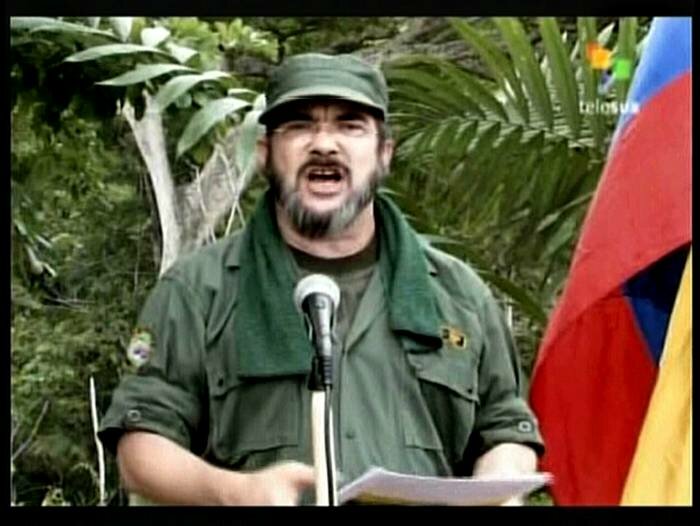
Colombia´s FARC leader Timochenko today confirmed the guerrillas´ intention to disarm if next month´s peace talks with President Santos´ government are successful.

In an interview with the Communist weekly publication Voz, Timochenko admitted that without a ´true farewell to arms´ any agreement would be worthless.

The interview is a clear response to critics – principally those loyal to ex-president Uribe – who question the will of the rebel group to put an end to 48 years of conflict. But the Voz is far from a neutral media outlet, and Timochenko´s words should not to be taken at face value.Nevertheless, the conciliatory tone and openness of the FARC leader to discuss the issues for which agreement are a prerequisite for peace, does offer us cause for a degree of optimism.

Scepticial, cautious optimism, that is.

Why? In a previous article I set out nine reasons to believe a different outcome to previous negotiations is possible. I highlighted the balance in the talks´ agenda – neither side will be able to argue that their areas of greevance were absent from the table – so often a reason for talks breaking down (think particularly in the case of the Isreal Palestinian conflict).

What is clear is that during the preliminary talks an agreement was reached between the government and the FARC, both on the hoped-for-outcome of the process, and, crucially, the route map to get there. This is something that plainly did not happen in Caguán (the previous talks, during the Pastrana years).

How did this work for both sides?

Government negotiators secured victory by forcing the FARC – for the first time – to accept the inclusion of disarmament on the agenda. Previous talks have focused on cease-fires but never disarmament.

And for the FARC team the ´red lines´ were the inclusion of land reform and political participation.

The serious of the agenda allowed Timochenko to draw a distinction with past talks when, as he say it, the major mistake was the government´s lack of ´real desire to address and find solutions to the causes that gave rise, and continue to feed, the conflict´. This time they will have the opportunity to push their world view.

Whatever you think of the FARC´s war, they were never going to give it up unless they could point to some success, some reflection of their view in government policy.

The FARC might now be considered as nothing much more than a narco-trafficking cartel, but their origins are based in political struggle, and Timochenko belongs to this ´philosophical wing´. Listen to him speak and it is impossible to avoid the rhetoric of the far-left; the paranoid anti-capitalist rage against a system that allegedly makes victims of us all.

Those who stand firm against the talks should be reminded that conflicts end either through obliteration of the enemy or through a form of negotiated quid pro quo. So long as the FARC can make money from selling drugs it is impossible to see how this war can end without compromise, unappealing as that may be.

So to expect capitulation from the guerrillas in return for jam tomorrow is naive. The guerrillas have to save face. They know the battle is lost and they cannot impose their brand of Marxism on the country. But they have to ´acheive´ something to be able to justify (to themselves and their sympathisers) laying down their arms.

A message to Uribe?

Uribistas have appeared on television and radio arguing that the FARC have no will, that this is a huge confidence trick. They might be right.

But for now it seems prudent to allow the president to get on with the serious task of convincing Timochenko to deliver on his promise  ´the abolition of the use of force – of appeal to any kind of violence – to achieve economic or political purposes´.

Because for the moment the alternative to these talks is clear, as prophesied by Timochenko,´the continuation of the conflict, more death and destruction, more grief and tears, more poverty and misery for some and greater wealth for others`.

If this proves to be a smokescreen then the FARC will have lost their last chance to pursue their ends through political means. Their slow death will continue, and tragically for Colombia it will take innocent lives with them.

The isolation of Álvaro Uribe?

These are worrying times for Colombia´s ex-president Álvaro Uribe, as the political tide turns against him, the media deserts him, and the governing class close ranks behind President Santos.

Is Uribe in danger of losing his political voice?

Whether you or I support him is irrelevant, it is a simple fact that many feel a very real connection with the ex-president. Uribe is a politician used to the limelight, and unconditional support and loyalty. In 2010 he left power as Colombia`s most popular ever president. And despite the attacks on his government throughout the last two years, he has maintained a strong following not only among those who instinctively share his politics, but among the millions – particularly in rural areas – whose feel their lives improved significantly during the Uribe government as the FARC was pushed back.

He will have been dismayed then by last week´s poll that showed his popular appeal as low as 53%. Ok, not disastrous for an ex-president, but the fall of 3% between June and September is now part of a negative trend.

The polls are one thing, but the national politics will be even more concerning.

Congress voted en masse in favour of President Santos´ peace talks, leaving Uribe – or at least Uribism – as the only force against them. Uribe will have hoped for more disquiet in congress, greater indication from his allies that they are with him; but for now Santos holds all the cards. The president even brought retired police  chief and rumoured potential Uribista candidate for the 2014 elections, Óscar Naranjo into the negotiating team, dufusing a potential opponent.

Following the vote, last Wednesday I spoke to Colombia Reports:

“As Santos’ coalition partners rally behind the president, Uribe is in danger of becoming a lone voice against the talks.”

“However, Uribe may prove to be right and if the FARC are bluffing, then the Conservatives and U Party members still loyal to the ex-president could well swing behind their old boss, and in a blink of an eye.”

“But for now the prudent thing for all politicians to do is to support the president, to wait if and until the talks break down to strike,”

All is far from lost for Uribe, the future in Colombian politics is famously impossible to predict, and sections of the political class could yet jump ship and join him – particularly as I said if the peace talks fail, and or as we approach the elections.But it also true that 77% of the population support the forthcoming peace talks, and no politician wins votes by telling their electorate that their dreams are built on false hope – at least not while the dream is still alive.Uribe´s politics of NO NO NO are finding it difficult to get traction outside his circle of ´true believers´.And finally, with the news last week that Pacho Santos has left his morning radio slot on RCN, Uribe has been left with precious few spokesmen in the Colombian media.

Pacho Santos was Uribe´s vice-president and has remained a fiel servant of his old boss. The morning show was seen as a counterweight to other, less Uribe-friendly output.

During the Uribe years the media was unquestionably on his side, perhaps unquestionly so. But President Santos – himself a former journalist, and of course familiarly tied to a media oligarchy – now has the vast majority of the nation´s mass communication outfits either on his side, or at least losely in his court.

According to La Silla Vacia, an independent digital news source, even the Medellín-based El Colombiano newspaper the number one cheerleader for Uribe in the written media is shifting slightly its editorial view following the departure of loyalist Ana Mercedes Gómez.

All this is a very different picture from that taken earlier in the summer when Uribe launched the new political movement Puro Centro Democrático (PCD) – the platform to take Uribism back to the presidential palace in the Casa de Nariño.

At this time, Santos was plummeting in the polls, the FARC were at war with the army in the south west department of Cauca, and the ex-president´s mano dura mesage of security was striking home. So while Uribe himself cannot stand himself for president, the nation was beginning to view at least curiously the emergence of a PCD candidate to lead the opposition to the Santos regime (and  to his re-election campaign in 2014). Uribe may win this battle in the long run, but Colombia must hope that Uribe is wrong and that the FARC will demobilise.

The ex-president would do well to prepare for this eventuality, and must begin to set out an alternative manifesto to the current government, a prospectus that goes beyond security and peace.

If he does not then the danger for him is that his isolation will be complete.

FARC`s PR war a threat to Colombian peace talks?

Colombia’s President Juan Manuel Santos is fighting a public relations war with FARC guerrillas who in days will fly to Norway to start negotiations to end five decades of conflict.
Peace depends on the will of the FARC to negotiate, and the ability of the government to provide the terrorists an alternative to armed combat.
The government has done its part.
Since coming to power in 2010, the president has rushed through a new legal framework of transitional justice that will permit integration of demobilised guerrillas into civilian life; offering a route to legitimate political representation through the power of the ballot box.    
But the key question is whether the FARC have done enough to show they too are serious about peace.  
Those loyal to ex-president Alvaro Uribe suggest not; pointing to the rebels’ press conference held last week in the safe-house of the Cuban capital, Havana, as evidence the FARC are playing a huge confidence trick. 
Hearing the mendacious words of the groups’ high command, it is tempting to agree with the Uribistas.
After months of preliminary talks between the FARC and the Santos government, the two sides had agreed a tight agenda for negotiations. But in Havana the FARC took advantage of the worldwide media attention to rip this accord apart.
Appearing to enjoy their moment in the sun these civilian and smartly dressed commanders announced they were placing new demands on the Colombian government. Now they would `fight’ for a bilateral cease-fire and for the inclusion of Simon Trindad in the process. 
Santos had previously promised that the army would not cede a millimetre of territory to the FARC and Trinidad is a prisoner in the US and is subject to the will of that country´s judiciary.
The FARC appeared to be constructing barriers, excuses to pull out of the talks and pass blame to the government.
All of a sudden the President was forced to negotiate with the FARC in public, no, he would not pull out troops he confirmed, and Trinidad, well that was out of his hands.
Echoes of the last, failed, talks in Caguan were being heard in the media, and Uribistas took to the airwaves to attack the inauspicious beginnings of this complicated process.  Their argument is clear – if the FARC are willing to negotiate, why are they going back on their word before the talks have even started?
For these sceptics the peace talks are in danger of becoming nothing more than a platform for the FARC to launch a public relations campaign, an opportunity to enjoy the oxygen of global media attention.
The fear is that, far from avoiding the errors of previous peace talks, President Santos is in fact falling into the FARC’s trap even before he has reached the table.
If it is true then that the FARC are setting the agenda in the media and that we are now engaged in a public relations war, surely we shouldn´t worry unduly – no sensible thinking person will take any notice of these criminals?
Unfortunately we shouldn`t be so complacent. As incredible and depressing as it may seem for those who have lived through the pain and suffering of the FARC’s nihilistic campaign of terror, there is a persistent level of support for the group’s ’struggle’; particularly in Europe.
For years the FARC has enjoyed financial and moral assistance from hard left groups across the Atlantic. The computers of Raul Reyes, killed by the Colombian military in 2008, showed us that the FARC is active in Holland, Germany, Italy, the United Kingdom, Sweden, Belgium, Turkey, and Norway (as well as Libya and Australia outside Europe).
NGOs, student movements and Marxist political parties are all implicated in this web of terrorism.We must remember too, that the Irish Republican Army provided training for the FARC.
Lamentably, this hypocrisy is still alive and kicking. Take the case of French journalist Romeo Langois who was ’abducted’ by the FARC earlier this summer. When released, Langois inexplicably claimed that there were ’neither good nor bad’ in Colombia’s conflict. Moral relativism must have clouded his view, perhaps allowing him to overlook the fact the FARC recruit hundreds of young children to fight their war.
Langois is not the problem but he is a symptom of the willingness of those untouched by the tragedy of the conflict to view the politics with frivolity.
So for Uribe, quite rightly, the thought of the FARC once again using the peace talks to lobby for their ’cause’ is a pill impossible to swallow. For the families of the FARC’s victims and for the majority of the 46 million Colombians who have never known peace it is equally sickening.
We must hope, however understandable that Uribe´s concern is, that it is misplaced.
The FARC might enjoy some level of international sympathy but it is difficult for them to disguise the fact they are a spent force.  The grandstanding of last week`s press conference speaks more of desperation to arrive at the negotiating table ready to play the best hand available, than of a group that seriously believes it can fool the people it continues to kill.
I draw hope from the fact the FARC are rumoured to have begun talks with Santos almost as soon as he took over from Uribe in 2010. So, despite the strikes against the group, the deaths of Mono Jojoy and supreme leader, Alfonso Cano, the FARC have not broken off these talks. The evidence suggests they are serious looking for a way out, a way of saving face. 
What is more, Timochenko is evidently a man with political ambition. He today opened a Twitter account and circulated through his aides the idea that the FARC could run a candidate for the 2014 Presidential elections. He appears to understand like Gerry Adams and Martin McGuiness before him, that the vote must replace the bullet.
We would be naïve to think the FARC won`t continue try to trick us between now and if and when there is an agreement (and of course afterwards) but we should not despair for the talks because of this.
Yes it is gut-wrenching to watch the narco-terrorists deny their involvement in drug-trafficking, and to claim innocently not to hold hostages in their power, but it may be that we will have to live with this if we want to give peace a chance. 
This story was published on Colombia Reports
Also published on Redes Colombia