#Timochenko

FARC peace accords signed by 22 February

Peace with the FARC guerrillas must be signed by 22 February to be put to a referendum on 25 October; the day of Colombia’s local and regional elections.

Colombia’s Constitutional Court has ruled that President Santos must present any peace agreement with the Marxist rebels to Congress no later than 24 February, and that the public must be told in advance of this date.

Read more…

Keep FARC leader Timochenko alive for peace?

Colombia has a loose-tongued president.

Yesterday, Juan Manuel Santos told us he knew where FARC commander alias Timochenko is hiding, but claimed he’d “think twice” before ordering a shoot-to-kill.

Mr Santos believes Timochenko is essential to the peace talks in Havana and that removing him would spell an end to the dialogues.

Read more…

FARC Santos govt peace talks, who and what?

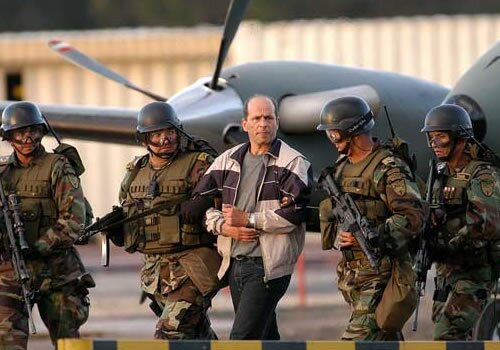
Alias Simón Trinidad, photo El Mundo


Colombia´s FARC guerrillas are scheduled to meet President Juan Manuel Santos´government in Oslo today ahead of a press conference on Wednesday to announce details of the official start of peace talks.

Although secret talks have taken place over more than a year, today´s meeting will be the first time the teams meet to begin the formal process of negotiating an end to the armed conflict which Colombia has lived with for nearly 50 years.

In this article, as part of a special series of reports on the peace talks, Colombia Politcs explores who the top team negotiators are, and what the agenda for the talks is.

Alongside this team there is also a second, sub group (each team has 10 in the team). It has been ´confirmed´too that the ELN will be present, as observers.

The government team:

Jorge Enrique Mora Rangel – Former Army commander.

Role: The voice of the armed forces. Who: During the government of Andrés Pastrana he was Army chief, and was highly critical of the process in Caguán.


Luis Carlos Villegas – Former President of ANDI

Role: Representative of the private sector, and business. Who:  Various diplomatic roles, secretary general of the National Federation of Coffee Growers, and former president of the National Association of Businessmen, ANDI.

Humberto de la Calle Lombana – Statesman

Role: Spokesman for the government negotiating team, and top politician. Who: Eternal statesman, Humberto de la Calle has been a supreme court judge, an ambassador, Vice President in the government of Ernesto Samper, and Interior Minister in the Pastrana administration.

Oscar Naranjo Trujillo – Former police chief

Role: Naranjo has been essential in warming up the police to the idea of the peace talks; a conduit to the forces. Who: Naranjo was police chief from 2007, retiring in June this year. He has even been touted as a potential future president.


Sergio Jaramillo – Peace Commissioner

Role: Official peace commissioner, has been present throughout the phases of negotiation. Who: Jaramilla is considered to be one of the authors of the Democratic Security doctrine of the Álvaro Uribe government and is valued for his coolness and ability to strategize.


 The FARC team:

Rodrigo Granda – alias ‘Ricardo Téllez’

Who: FARC ´foreign minister´, who worked alongside Raul Reyes in establishing the ´foreign committee´. He was captured in Venezuela and then released by President Álvaro Uribe as part of the attempts to release Ingrid Betancourt.


Jesús Carvajalino – alias, ‘Andrés París’

Who: Member of the ´foreign committee´and has been a negotiator
in the last three peace processes.


Luciano Marín Arango – alias ‘Iván Márquez’

Who: The FARC´s spokesman in the process. Márquez is second in command of the FARC Secretariat. Was Congressman for the Unión Patriotica between 1991 and 1992.


Luis Alberto Albán – alias ‘Marco León Calarcá’

Who: Part of the ´foreign policy team´of the FARC, and leader of the Mexican front. Present in Caguán.


Ricardo Palmera – alias ‘Simón Trinidad’

Who: Palmera is imprisoned in the USA, serving a 60 year sentence (and his participation is dependent on US co-operation). Born into a rich family, Trinidad rose through the FARC´s ranks to become a commander of the group´s Caribbean front. Also present in Caguán.

The agenda

The agenda for the talks was established during the exploratory phase of the discussions, in Havana.

There are five thematic issues.

1. Agricultural development policy – agrarian reform. 

Agreement will be sought on the following areas:

  • Access and land use
  • Territorial specific development programmes
  • Infrastructure
  • Social development: health, education, housing, poverty eradication
  • Providing stimulus to agricultural production
  • Food safety.

2. Political Participation

Agreement will be sought on the following areas:

  • Rights and guarantees for the exercise of political opposition
  • Democratic mechanisms for participation
  • Measures to promote greater political participation across the board.

3. Ending the conflict

Agreement will be sought on the following areas:

  • Ceasefire and cessation of hostilities, (bilateral and definitive)
  • Laying down of arms
  • Integration of the FARC into civilian life
  • Government review of those captured for links to the FARC
  • Government´s fight against criminal organizations
  • Government institutional reforms necessary to build peace
  • Security guarantee (think Unión Patriotica).

4. Finding a solution to the problem of illicit drugs

Agreement will be sought on the following areas:

  • Public health programmes
  • Prevention programmes
  • Production and trafficking.

5. Victims

Agreement will be sought on the following areas:

  • Human rights of the victims.
  • Truth commission

The sixth item on the agenda relates to the logistics of the implementation (and monitoring) of the agreement.

Colombia Politics will follow the process and not only provide reports as the talks progress, but also analysis and commentary on the political temperature in Colombia.

The FARC in Congress?

How will the army view the FARC in Congress?

Colombian President Juan Manuel Santos plans to allow the FARC to fight for seats in congress.

For many in Colombia the mere thought of a Timochenko in a position of power is enough to make the blood boil. How can a mass murderer enter parliament, they say? How can the families of the victims killed by the 45 years of terror be expected to react to the sight of this criminal pretending to represent the electorate?

They have a point, but however difficult it is to live with, we are going to have to get used to the idea of former combatants fighting for our vote.

President Santos confirmed as much in an interview with CNN while in the US last week.

In the UK they have grown accustomed to the site of former terrorists now in power, Following the Good Friday Peace Agreement of 1998, the IRA promised to disarm and began the process of choosing politics over violence.

But in Northern Ireland these former guerrillas are not just any ordinary senators or parliamentarians – they have been elected to govern, and they hold some of the top jobs.

In Colombia it is virtually impossible to foresee a Timochenko becoming president, or vice president. The thought of his even occupying a ministerial role appears more science fiction than potential reality.

But while we look to the example set in Northern Ireland we should remind ourselves that demobilised guerrillas have been reintegrated into society and have played a role in the nation´s political life even here in Colombia.

Two former M-19 guerrillas are now emblematic leaders of the left, perhaps their most electorally succesful in recent years. Gustavo Petro is of course Mayor of Bogotá and Antonio Navarro Wolff is a former Governor of the department of Nariño.

So, starting from the basis that, should the peace process be successful, political actors (either ex-guerrillas themselves or those sympathetic to the group´s professed ideology), the question is when to expect them to take to the national stage, and in what form.

Evidently we will not know for certain until after the peace talks have concluded, but there has already been speculation that candidates will be put forward for the congressional elections in 2014.

It is difficult to see how the talks could be concluded and the necessary amendments made to the constitution in time for such an eventuality. Nevertheless, it is possible that the FARC could lend their support to candidates that are sympathetic to their cause but were not active in combat.

Piedad Córdoba´s Marcha Patriótica is a movement that shares at least part of the prospectus put forward by the rebels.

The Marcha Patriótica is currently on a tour of Europe, forming alliances with far left politicians there – alliances that could well be used to finance electoral battles and or to provide campaign assistance.

Córdoba denies the link between the FARC and her political ´party´, but for Defence Minister, Pinzón the ties are irrefutable. Córdoba, it should be remembered, has been banned from occupying a congressional post because of her closeness to the guerrillas.

Amid these rumours that suggest we may see, as soon as the end of next year, the beginning of an official FARC or post-FARC political campaign, news emerged today via the new Interior Minister, Fernando Carillo, that the government is planning a legislative reform of the electoral code – a reform that many have suggested has been designed to permit just this.

Carillo is expect shortly to present the bill to congress, but denies that it has been cooked up to allow rebel participation at the ballot box. Carillo took to the airwaves this morning to argue that the reform is necessary to iron out the wrinkles that have crept into the system over the last 26 years.

Participation is explained is something that cannot be decided by congress, but requires a change to the constitution, which in turn demands presidential approval.

However, Carillo´s interview left the listener less than convinced.

Although it is true that the president must authorise the change, it does not mean that congress cannot examine the issue and propose it – indeed pass the law and offer Santos the opportunity to rubber stamp.

Equally, although the government has not planned to include participation in the legislation as presented to parliament, we all know that senators and representatives have the ability to amend, to add or to remove clauses as the bill passes through both houses. That is the nature of the presidential and bicameral system.

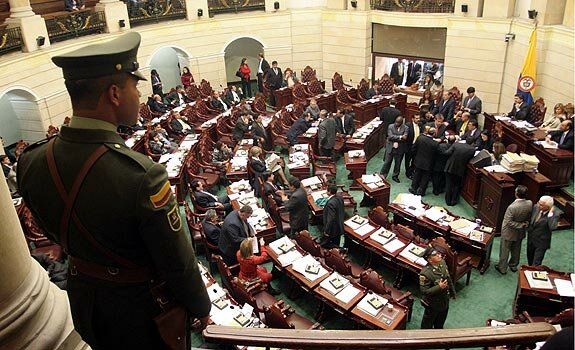
In other words, it is perfectly possible that discussion of the FARC´s involvement in Colombian politics could be heard in parliament within weeks – concurrent with the peace talks.

Is this a worry? Perhaps so if you belong to the part of society appalled by the idea of former terrorists in positions of political power.

For those who analyse other peace processes, however, it appears that such steps are necessary and unavoidable.

The final judgement will always lie with the people. We are not compelled to vote for those who march to the FARC´s colours. And yes, I realise that Colombia´s democracy is far from perfect and that the electoral system is subject to distortion, but that is another issue the country faces,

At the end of August the Attorney General, Eduardo Montealegre said he would ´rather see (the FARC) in congress than causing violence´. He may well get his wish.

Also published Redes Colombia
FARC guerrillas to disarm

Colombia´s FARC leader Timochenko today confirmed the guerrillas´ intention to disarm if next month´s peace talks with President Santos´ government are successful.

In an interview with the Communist weekly publication Voz, Timochenko admitted that without a ´true farewell to arms´ any agreement would be worthless.

The interview is a clear response to critics – principally those loyal to ex-president Uribe – who question the will of the rebel group to put an end to 48 years of conflict. But the Voz is far from a neutral media outlet, and Timochenko´s words should not to be taken at face value.Nevertheless, the conciliatory tone and openness of the FARC leader to discuss the issues for which agreement are a prerequisite for peace, does offer us cause for a degree of optimism.

Scepticial, cautious optimism, that is.

Why? In a previous article I set out nine reasons to believe a different outcome to previous negotiations is possible. I highlighted the balance in the talks´ agenda – neither side will be able to argue that their areas of greevance were absent from the table – so often a reason for talks breaking down (think particularly in the case of the Isreal Palestinian conflict).

What is clear is that during the preliminary talks an agreement was reached between the government and the FARC, both on the hoped-for-outcome of the process, and, crucially, the route map to get there. This is something that plainly did not happen in Caguán (the previous talks, during the Pastrana years).

How did this work for both sides?

Government negotiators secured victory by forcing the FARC – for the first time – to accept the inclusion of disarmament on the agenda. Previous talks have focused on cease-fires but never disarmament.

And for the FARC team the ´red lines´ were the inclusion of land reform and political participation.

The serious of the agenda allowed Timochenko to draw a distinction with past talks when, as he say it, the major mistake was the government´s lack of ´real desire to address and find solutions to the causes that gave rise, and continue to feed, the conflict´. This time they will have the opportunity to push their world view.

Whatever you think of the FARC´s war, they were never going to give it up unless they could point to some success, some reflection of their view in government policy.

The FARC might now be considered as nothing much more than a narco-trafficking cartel, but their origins are based in political struggle, and Timochenko belongs to this ´philosophical wing´. Listen to him speak and it is impossible to avoid the rhetoric of the far-left; the paranoid anti-capitalist rage against a system that allegedly makes victims of us all.

Those who stand firm against the talks should be reminded that conflicts end either through obliteration of the enemy or through a form of negotiated quid pro quo. So long as the FARC can make money from selling drugs it is impossible to see how this war can end without compromise, unappealing as that may be.

So to expect capitulation from the guerrillas in return for jam tomorrow is naive. The guerrillas have to save face. They know the battle is lost and they cannot impose their brand of Marxism on the country. But they have to ´acheive´ something to be able to justify (to themselves and their sympathisers) laying down their arms.

A message to Uribe?

Uribistas have appeared on television and radio arguing that the FARC have no will, that this is a huge confidence trick. They might be right.

But for now it seems prudent to allow the president to get on with the serious task of convincing Timochenko to deliver on his promise  ´the abolition of the use of force – of appeal to any kind of violence – to achieve economic or political purposes´.

Because for the moment the alternative to these talks is clear, as prophesied by Timochenko,´the continuation of the conflict, more death and destruction, more grief and tears, more poverty and misery for some and greater wealth for others`.

If this proves to be a smokescreen then the FARC will have lost their last chance to pursue their ends through political means. Their slow death will continue, and tragically for Colombia it will take innocent lives with them.

Peace in our time

Colombian President Juan Manuel Santos today set a timetable for an end to Latin America’s longest-running armed conflict announcing that peace talks with FARC guerrillas will begin in October and conclude within ‘months’.
At 12.30pm, to a television audience of millions and flanked by the nation’s military leaders and his cabinet, the president confirmed what for months rumours have dared to speculate; Colombia’s bloody and pointless war could be over next year (before the presidential elections of 2014).

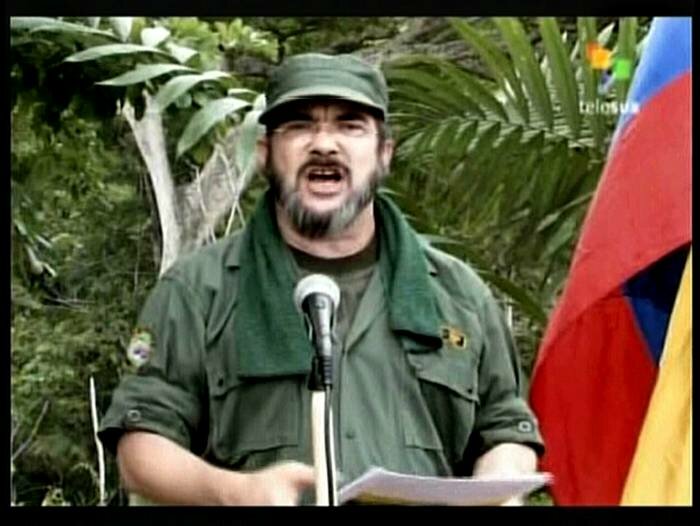
Within the hour, FARC leader Timochenko, took to the airwaves from the safe-house of Cuba. With his professorial beard and camouflage livery the rebel chief spoke at length, spitting out his Marxist hatred, and in the end resigning to the reality that peace cannot be achieved by ‘war’ but only through ‘civilised dialogue’.

Frankly, the game is up for the FARC, and they know it; their dream of a Communist revolution is in tatters as Colombia develops into one of the fastest growing economies in the world, and as its people in record number are lifted out of poverty.

Timochenko understands he must save face and secure a dignified exit for his jackbooted comrades. The negotiating table is the only way out for his cornered rabble.

Yet there are those in Colombia who remain understandably sceptical that these kidnappers, extortionists, murderers and torturers have the will to bid a farewell to arms.

None more so than ex-President Álvaro Uribe who this afternoon launched a tirade of abuse at the FARC and also at what he sees as a government of appeasers. For Uribe, Santos is rather like 1930s British Prime Minister Neville Chamberlain who announced he had secured ‘peace in our time’ a year before Hitler’s aggression sparked World War II.

Uribe argues the government is acting in haste, sacrificing the advances in security made during his eight years in power to secure re-election in two years’ time.

How can you trust a FARC who refuse to enter into a ceasefire and who threaten to continue the bombing and the killing throughout the peace talks? How can the political elite sit at the table with these criminals to discuss peace while the military is at war? Uribe’s rhetoric certainly resonates with sections of a society tired of the FARC’s duplicity, and chastened by the disappointment of previous promises for a negotiated cessation of violence.

Time will tell whether the detractors are right and whether the FARC is bluffing, but I see cause to be hopeful that they are not. Last week I set out nine reasons why these talks are different from the past failures, and why a successful outcome is within reach.

There is not space here to reiterate them, but the overwhelming truth is that balance in power is different now than it was at the end of the last century when the then President Andrés Pastrana initiated talks in Caguán. Then the FARC believed they had a chance of installing a Communist state, and the Colombian government sat down with a weak hand. Now the guerrillas are a depleted force, in troops, in morale, and in leadership (both the military chief strategist Mono Jojoy and the previous overall leader, Alfonso Cano have been killed in the space of the last two years). It is time to face the reality of defeat.

Another reason for hope, overlooked by some, is that since coming to power in August 2010, the Santos government has paved the way for peace through a series of important legislative changes that allow for the integration of the FARC into civil society; an opportunity to pursue their ends through politics rather than armed combat.

The new transitional justice law allows Santos to place a meaningful offer on the table, one that Timochenko should take.  Provision is made within this law for reduced penal sentences (but not impunity) and the possibility of elected political representation (potentially throughout the tiers of governance) for those who share the FARC’s philosophy.

As with the IRA in Northern Ireland, the ballot box must replace the bullet. Martin McGuiness and Gerry Adams before the ‘Good Friday Agreement’ of 1998 were terrorists. Both have since been at the top of Northern Irish politics and presided over perhaps the most successful decade in the country’s history.

The IRA famously trained the FARC during the 80s and 90s. It would be less than surprising if Timochenko has one eye on following in the footsteps of his former comrades.

We are about to enter into a crucial period in Colombian history. Santos may be remembered as the father of peace and the president who finally ended one of the world’s most bloody insurgencies.  Alternatively, the FARC could again pull the plug, and prove Uribe right.

Timochenko’s discourse today in which he spoke of capitalism’s dehumanisation and enslavement of the people, in which he spoke of an ‘alternative Colombia’ sounded more like a manifesto launch than an indignant battle cry. For those on the far left, currently represented by Piedad Córdoba’s Marcha Patriótica, this was a clarion call, a sign to ready for an election campaign – perhaps as early as the congressional elections in 2014. While it is too soon for the ‘new, civilian FARC’ to have a presence, former commanders may urge sympathisers to unite around Córdoba.

Finally, Timochenko is wrong to say that dialogue is the end – disarmament is the end. We will not believe the FARC until they lay down their arms.

The might of rhetorical argument must replace the bullet of terrorism.

This was a piece for Colombia Reports.

FARC´s PR war as peace talks loom

FARC fighters, many are women and children.

Colombia’s FARC guerrillas yesterday released a video of combatants rapping about forthcoming bilateral peace talks with the government, the details of which President Juan Manuel Santos will confirm at 12.30today in a special address to the nation.
The process will be long and arduous and the outcome is unknown, but this is the best chance for peace in the history of the near 50 year conflict.
If peace is the end game, this video, which attempts to present a humorous side to the brutal reality of this terrorist group, is the start of a fierce public relations war in which the battle is for the hearts and minds of the 46 million Colombians that make up this Andean nation.
A music video circulated yesterday in which FARC foot-soldiers appear in combat gear and t-shirts marked with the face of the Argentine revolutionary Che Guevarra singing along to a five minute parody of the peace talks scheduled to take place in October.
The film is amusing (but ultimately offensive given its origin) and pokes fun not only at the government, and Colombian society, but also at the guerrilla group itself. No one should be fooled however; this is a clever political broadcast designed to disseminate the FARC’s message ahead of President Santos’ speech to the nation this afternoon.
When the President speaks from the press office of the Casa de Nariño, as millions of Colombians sit down for the traditional family lunch, he is expected to allude to the mistakes of the past, the tragedy and criminality of the war, and point the way to the sunlight uplands of a Colombia in peace.
He will be prudent, but optimistic, and ask the nation to join him, to lend him their support and together work to secure a permanent disarmament of the FARC and an end to this pointless and bloody insurgency.
Colombian society is split; for some, the desire for peace does not win over the scepticism and hatred for a duplicitous FARC that has brought misery to the country while it pursues communist revolutionary ends.
Santos has reshuffled his government and prepared a detailed communication strategy to help build popular support which he hopes will fight off the snipping from the sidelines and the fierce opposition to negotiations that ex-president Alvaro Uribe has been fuelling since news of the talks emerged last week.
Polls suggest that, for now, over half the nation support the talks and the efforts of the government to secure peace. As the agenda for the talks becomes known today and as the bitterness increases ahead of the first meeting expect to be in Oslo (later the negotiations will move to Cuba) it is unclear how this generosity of spirit will hold up.
Worse still, once the table is set and the real discussions begin, the distrust and fear will begin in earnest. Will Colombian accept a legitimate political role for the FARC, will they accept reduced sentences for those who have committed crimes against humanity? The campaign run by Uribistas (those loyal to the ex-president) is centred around the simple but effective message – ‘Peace, but not at any price’. It is a message that it already resonating.
Both sides – the government and the FARC – are working to ensure they enter the talks with the best possible hand. Any weakness on either side will be capitalised on. The FARC know that Santos’ mandate is based on the will of the people, and they will fight dirty to move public opinion towards their position, and away from that of the government.
Watching the video (judge for yourself, left) closely it is clear that the FARC are not only attempting to present a human side, attempting to build an empathy with the nation, but they are also satirising the government.
Santos is lampooned as a member of the bourgeoisie, a political oligarch; distant from the working and middle classes. Their message is clear – the FARC represent the ‘pueblo’, and theirs is the same fight as the near 50% of Colombians who live in poverty (pure theatre of course). The president is also given the nickname ‘Chucky’ in an allusion to a popular series of 90s horror films (to whom Santos is alleged to bear an unfortunate liking).
The selection of young – men and women – fighters who look and sound (more or less) like ordinary Colombians is an obvious tactic to increase their reach into an uncertain public, as is the selection of the Che -faced t-shirts.
Guevarra remains an idol among the romantic left and student movements the world over. No matter that he was a murderous supporter of oppressive regimes; his is a ‘fight the system’ narrative that attracts a hippy and pseudo-socialist cult following.
There is little doubt that some in Colombia (and across the world) will identify with these misguided revolutionaries.
At the end of the video, ‘Timochenko’, the supreme leader of the FARC appears to announce that the rebels will enter into the talks without ‘rancour or arrogance’. For him this is a show of willing, a public commitment to the fight for peace. Nevertheless, the bombs and the attacks continue and the FARC are far from anything resembling a cease-fire.
This video is a highly cynical piece of PR. The phony war is over. The fight for peace and public opinion has begun.
As its fades to black, the video leaves us with Timochenko’s promise that victory will be theirs. We must hope he is referring, as Santos did last week, to ‘peace’ as being ‘the victory’. All eyes turn now to President Santos who will take the stage in a matter of minutes.
Also published on Redes Colombia