Show summary Hide summary
A dispute over teacher shortages that began at a high school in a Paris suburb in mid‑September has erupted into nationwide unrest, with more than 6,100 people detained and Prime Minister Sébastien Lecornu suspending high school classes across France for the rest of the week on October 6, the interior ministry said. What began as student blockades over staffing and dilapidated facilities has drawn major labor unions into the streets, left dozens of schools closed or damaged and forced a national political reckoning months before the 2027 presidential vote.
How a local blockade became a national movement
The protests trace back to September 17, when students at Lycée Saint‑Exupéry in Créteil, a working‑class suburb southeast of Paris, staged a blockade to support teachers denouncing shortages of staff and resources. Videos shared on Snapchat and Instagram spread the action rapidly through the Île‑de‑France region, and within days dozens of schools joined. Two student organizations — the Union Syndicale Lycéenne (USL), led by president Ryad Rani, and the Union Étudiante (UE), created in 2023 — coordinated a national day of blockades on September 29 that coincided with a planned public‑sector strike.
DCCC seeks ads criticizing GOP approach to AI and data centers across dozens of House races
Clock shows 2:57
Within weeks the movement crossed borders: students in Liège, Belgium, staged disruptions on October 1 amid their own education debates, influenced in part by the French protests.
What students are demanding
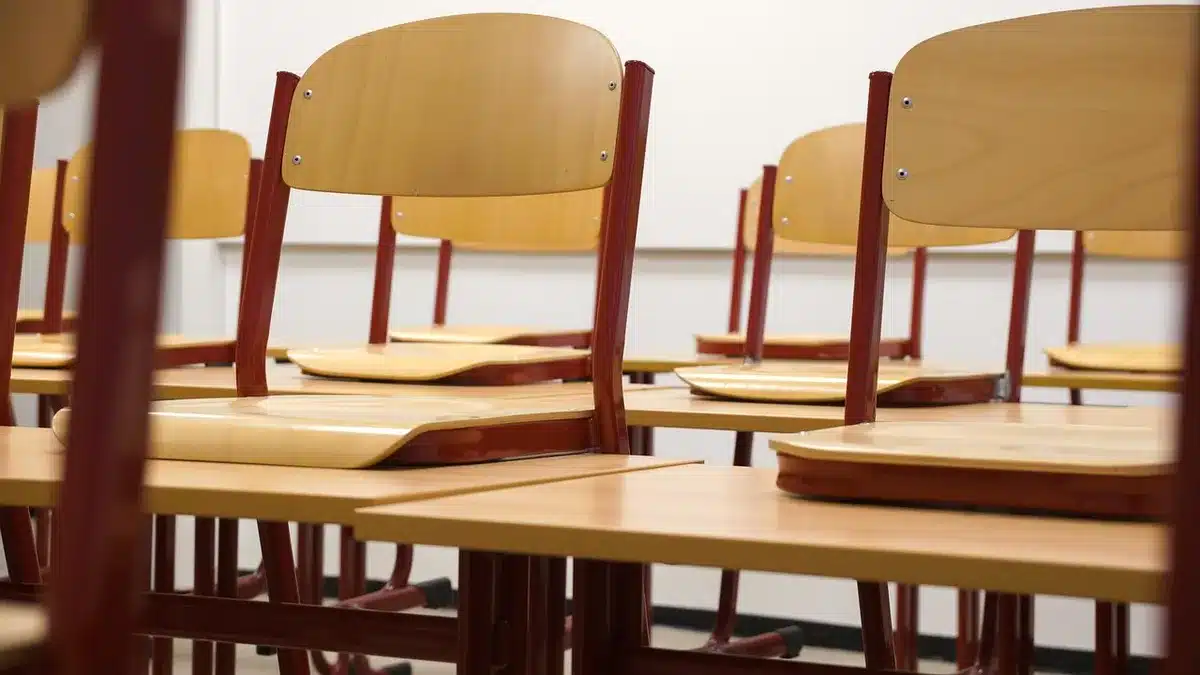
Students and parents have described concrete, structural grievances: class sizes routinely reaching 32–36 pupils, prolonged teacher vacancies, decaying buildings in lower‑income districts and long school days that leave little time for rest. Students preparing for the baccalauréat also cite anxiety over the Parcoursup university admissions algorithm, which they say can allocate them to distant universities with limited recourse.
“Today our school is paralyzed due to a lack of resources, teachers, and not enough desks,” a student told AFP, a remark reported by NPR. Education Minister Édouard Geffray has acknowledged some concerns are legitimate and require a concrete government response, while senior officials have accused hard‑left actors — including members of Jean‑Luc Mélenchon’s France Unbowed (LFI) — of seeking to radicalize the movement, a claim student unions reject.
The Lens injury and questions over policing
The protests took a particularly inflammatory turn on October 5 outside Lycée professionnel Auguste‑Béhal in Lens, where a 15‑year‑old student was gravely injured by an exploding device and later lost his hand and part of his forearm at a Lille hospital. Accounts of the incident differ: a police union source told AFP that the student appeared to have picked up a sting‑ball grenade that detonated in his hand, while a fellow student quoted by Catalan outlet Ara said the device struck the boy without him having picked it up. Public prosecutors said investigators had not yet established which version was accurate.

The interior ministry confirmed that multiple investigations into police conduct had been opened since the protests began, with at least three specific probes recorded as of October 2. Parents and demonstrators have argued that crowd‑control tactics designed for adult crowds should not be used against teenagers; police and government officials counter that officers faced organized violence on protest fringes.
Unions join the movement and the stakes rise
On October 6 major French labor unions marched alongside students in Paris, Lille, Lyon, Marseille, Toulouse and other cities, broadening what had been largely a youth‑led campaign into a wider social protest. The same day, the prime minister suspended high school classes nationwide; that day alone, nearly 2,000 high schools were reported blockaded or closed. Authorities say at least 215 students and 715 police officers have been injured and that 24 schools have been burned or ransacked during the unrest.
Observers note echoes of the Yellow Vest movement and the 2023 nationwide strikes against pension reform. The government’s room for maneuver is constrained by fiscal pressures: INSEE reported public debt at 119% of GDP in the second quarter of 2026 and an annual budget deficit of about 5.4% of GDP, nearly double the EU’s 3% reference limit. Negotiations over pay and public spending are unfolding against that backdrop, complicating the government’s ability to promise new resources.
Political implications ahead of 2027
President Emmanuel Macron has offered limited public comment, acknowledging young people’s anxieties but condemning attacks on police and teachers; much of the day‑to‑day response has come from the prime minister and other ministers. With France’s first presidential ballot scheduled for April 18, 2027, and Macron barred by the constitution from seeking a third consecutive term, each week of sustained unrest reshapes the political field and offers opportunity to candidates from the far right to the center‑left who portray themselves as alternatives to the current administration.
The students who began blockading Lycée Saint‑Exupéry six weeks ago asked for more teachers and functioning classrooms. Their action has grown into a nationwide confrontation that will be hard for any prospective government in 2027 to ignore.