
Show summary Hide summary
Russian forces launched a three-wave barrage of 21 ballistic missiles at Kyiv overnight on October 21–22, killing at least one person and wounding dozens, the attack coming hours after a U.S. envoy concluded talks with President Vladimir Putin in St. Petersburg that Moscow said left it willing to resume trilateral negotiations. Kyiv reported zero interceptions of the ballistic missiles and widespread damage across the capital, underscoring a gap between diplomatic signals and battlefield realities.
Three waves, no interceptions
Ukrainian President Volodymyr Zelenskyy said the strikes struck Kyiv in three distinct waves — at roughly 10 p.m., 2 a.m. and 3:30 a.m. — accompanied by a separate barrage of about 210 drones, 181 of which Ukraine’s air defenses shot down or electronically suppressed. According to the reporting, none of the 21 ballistic missiles were intercepted.
Russia strikes Kyiv with cluster munitions after agreeing to hold peace talks
Burnham vows to lead on climate after UK approves drilling

Ukrainian officials and analysts attributed the failure to a shortage of Patriot PAC-3 interceptors, the only system Ukraine currently fields that can reliably engage high-altitude ballistic threats. The report says Zelenskyy had pressed Washington in the days ahead of the attack to accelerate resupply; in response, Marco Rubio was quoted as saying “nothing has changed,” while American officials cited depleted stocks following what the report described as eight months of the Iran conflict.
A meeting in St. Petersburg, and immediate escalation
The strikes came just hours after U.S. Special Envoy Steve Witkoff concluded a roughly three-hour meeting with Putin at the Constantine Palace in St. Petersburg. Jared Kushner participated in part of the session by video link, the report said. Kremlin foreign-policy adviser Yuri Ushakov told reporters afterward that Putin was, “in principle,” ready to resume three-way talks with the U.S. and Ukraine, possibly around November 10 in Abu Dhabi.
Witkoff had flown to Russia after talks in Oslo on October 20 with Ukrainian and European officials and told reporters he felt there was “some degree of momentum.” U.S. officials later described the session with Putin as “constructive,” and said technical-level negotiations between the three parties could resume — a characterization that was not shared by all participants, according to the source, which quoted a senior Russian official describing the meeting as “relatively short and not substantive.”
Goodwill gesture before the strikes
The account notes that at the start of the meeting, Russia freed retired American teacher Stephen Hubbard and presented his release as a goodwill gesture. Within hours, the missile strikes on Kyiv were underway.
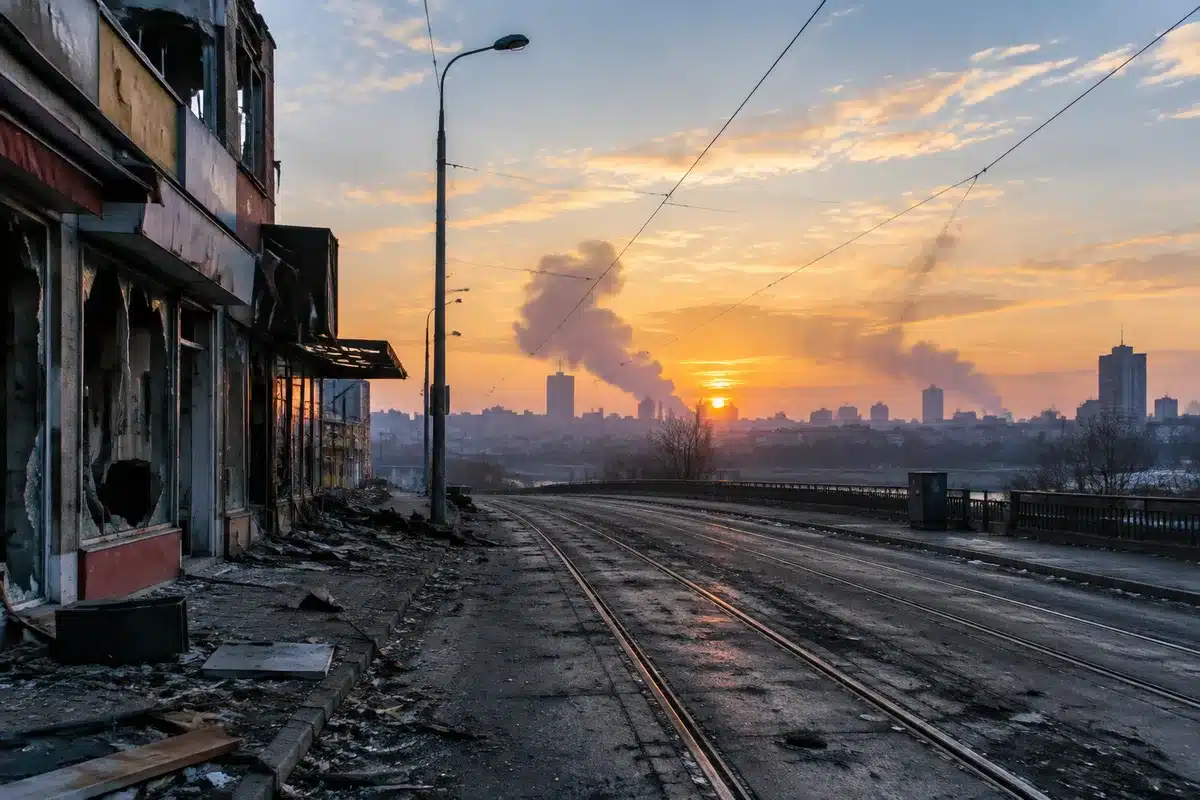
Ukraine’s air force identified the weapons used in the attack as a mix of Iskander-M, modified S-400, Zircon and Onyx missiles, and said three of the 21 carried cluster warheads — munitions that disperse many smaller bomblets over a wide area. Strikes damaged railway stations, energy infrastructure, apartment buildings, metro facilities, shopping centers and businesses across Holosiivskyi, Obolonskyi, Pecherskyi, Sviatoshynskyi and Dniprovskyi districts.
Cluster warheads hit Kyiv’s historic district
One of the cluster-armed missiles struck the Pechersk district, the report said, landing in the area between the Kyiv‑Pechersk Lavra monastery complex and the Sviato‑Vvedensky Monastery and damaging religious buildings, homes, shops and cafés. Emergency crews were still battling fires at dawn. Zelenskyy’s tally for Kyiv and its surrounding region reached 34 injured, including five children; the capital recorded one fatality. Strikes across 12 regions of Ukraine overnight brought the national death toll to at least four after a missile hit a marketplace in the eastern city of Lozova, killing two women.

Reciprocal strikes and competing claims
The source reports that Kyiv responded with hundreds of drones launched at Moscow and other Russian cities during the same hours. Russia’s Defense Ministry said its forces downed 808 Ukrainian drones in a single night, and Moscow Mayor Sergei Sobyanin said 630 of the drones were aimed at the capital.
Diplomatic gap remains wide
The account highlights that Moscow’s stated conditions for any ceasefire remain unacceptable to Kyiv: Russia continues to press for Ukraine to formally cede the four occupied regions of Donetsk, Luhansk, Zaporizhzhia and Kherson and to withdraw forces from them before a truce — demands Kyiv rejects as sealing its loss of territory. Moscow has also rejected a European-led peacekeeping presence inside Ukraine, another condition Kyiv considers essential for any durable deal.
Zelenskyy publicly ridiculed Witkoff’s earlier praise of Putin as a “humanitarian,” calling the missile attacks the appropriate context for that label and urging immediate acceleration of air‑defense deliveries and new sanctions on Moscow. The reporting concludes that while talks may now be scheduled in principle, both sides are approaching any potential November negotiations from an ongoing, and intensifying, battlefield confrontation.