Show summary Hide summary
A drone-released grenade struck a Colombian Navy patrol boat on the Guapi River in Cauca on Friday morning, killing one marine and wounding four others, the Navy said. The service attributed the attack to a FARC dissident cell and described it as a criminal act that violates international humanitarian law, while investigators consider whether the strike was retaliation for recent security operations in the region.
A grenade dropped from the sky
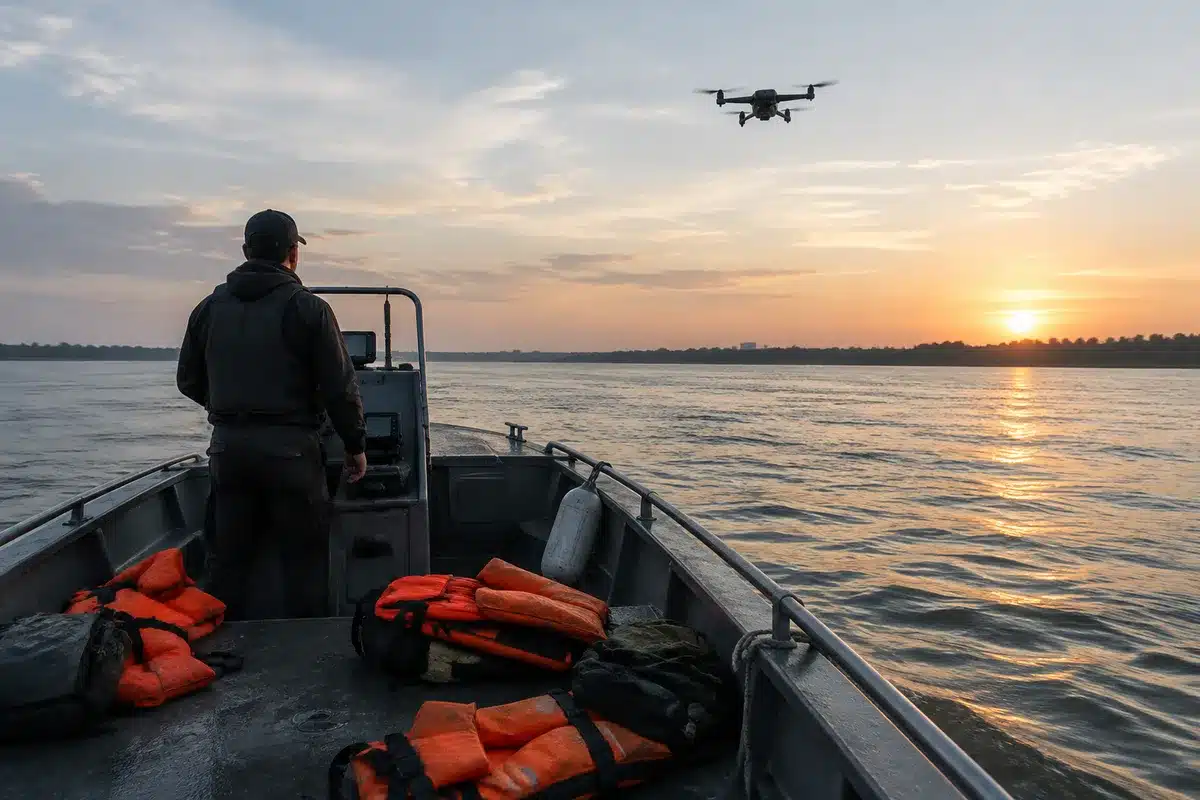
The incident occurred at about 10 a.m. in Bocas de Penitente, in the coastal municipality of Guapi, when a unit from Batallón Fluvial de Infantería de Marina N.° 42 was conducting offensive operations against illegal armed groups, the Navy reported. A drone released a grenade onto patrol vessel ARC 1200; the device detonated on impact.

The marine killed was identified as Edwin Andrés Vargas Londoño, 23, a marine professional with one year of service. Four crewmembers — Yesi Ángulo Ángulo, Juan Nicolás Hernández Cruz, Camilo Sebastián Fuertes Chalama, and Yeider David Ruiz Lozano — were wounded, removed from the damaged vessel and airlifted to medical facilities in Cali. Their conditions had not been publicly disclosed as of Friday night, according to the Navy statement.
Who is behind the strike?
The Navy, via Brigada de Infantería de Marina N.° 4 of the Pacific Naval Force, formally attributed the attack to Estructura 30 Jhonier Toro Arenas (also described as the Jhonier Toro Arenas structure), a FARC dissident cell within the Bloque Occidental Jacobo Arenas. The communiqué expressed condolences to the fallen marine’s family and said the institution would file a criminal complaint for the “terrorist attack” that it said flagrantly violated international humanitarian law and human rights.
Investigators are also examining a possible retaliatory motive. Reporting by RT Actualidad cited a potential link between the drone strike and the recent killing of alias “Marcos Pacífico,” a senior ELN commander in Cauca, along with nine of his fighters, in operations by Colombian security forces in the days before the attack. President Abelardo de la Espriella, who took office in August 2026, has maintained an aggressive military posture toward the ELN since his inauguration, the reporting noted.
Another fatal ambush the same day
The Guapi strike was one of at least two deadly attacks on Colombian security forces that Friday. In the corregimiento of Guachaca, near Santa Marta, soldiers from Batallón de Montaña N.° 6 were ambushed with rifle and machine-gun fire during operations against the Autodefensas Conquistadoras de la Sierra Nevada. The Ministry of Defense identified the soldier killed as Brajhan Daniel Ropero Lozano and condemned the killing as a “cowardly assassination.” A second soldier was wounded in that attack.
The Pacific as a growing aerial battlefield
Friday’s events come amid a broader increase in drone attacks by armed groups across Colombia. Al Jazeera reported that drone strikes on security forces more than doubled in early 2026 compared with the same period the previous year, and by March the country was recording roughly one aerial attack every day and a half. The Pacific coast — long contested by FARC dissidents, ELN cells and narcotrafficking networks — has emerged as a principal testing ground for improvised aerial tactics, with Cauca accounting for the majority of drone-related military casualties, according to international reporting.
Civilian impact and military response
Beyond the immediate military toll, the attack on the Guapi River raises concerns for riverine communities that rely on the same waterways for transportation, trade and access to services. Local residents have limited ground routes, meaning escalations in drone activity can further restrict safe movement and access to basic needs.
Colombia’s armed forces pledged to reinforce their operational presence in the Guapi area following the strike. Whether increased deployments will deter further drone operations or instead draw more attention from armed groups seeking to test aerial capabilities is a strategic question that officials and analysts say will shape the coming weeks in one of the country’s most contested river systems.
Reporting and official statements cited in this article include communiqués from Colombia’s Navy and Ministry of Defense, RT Actualidad’s coverage of recent operations against ELN commanders, and Al Jazeera’s reporting on trends in drone attacks.