Friday, 25 November 2011

Uribe v. Santos - Colombia's top politicians at war

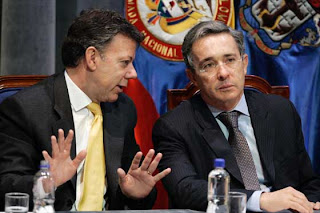
'Hypocritical' 'hostile' and 'lacking in popular support' - these were the words former president Alvaro Uribe this month chose to describe his successor, President Santos.
 
In the 2010 presidential elections, Santos was Uribe's candidate. So much so, that Santos, in his victory speech, acknowledged that Colombians had voted as much for him as for Uribe. Yet after a series of high-profile public disagreements both over the direction and the style of the Santos government, Uribe, has come out as the most vocal - and powerful - opposition to a regime that controls over 90% of the Colombian Congress.

Uribe, dismayed by how his former apprentice is governing, has fired the first shots in the battle for the presidency in 2014. It is unclear whether Santos will run again. But if he decides to do so, Uribe now looks certain to pitch his own - opposition - candidate. The Uribe / Santos split is more than a spat. It will provide the backdrop to the power struggle at the heart of Colombian politics in the years to come.
Tuesday, 22 November 2011

British eye Colombia as Santos' pro-investment politics bear fruit

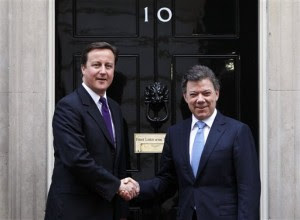
After meeting British Prime Minister Cameron and taking tea with HM the Queen yesterday, President Santos announced that British businesses will invest over 3.5 billion dollars in Colombia over the next three years. 


Santos arrived in the UK as the head of the CIVET group of emerging economies; his mission to promote trade ties with a country that until recently has appeared to ignore the opportunities Colombia's fast growing economy affords.  

The President claims that Colombo-British relations have never been so good, that there 'has never been so much interest in what's happening in Colombia'. If this is true it is in both nations' interest.

As the US and EU economies falter, the UK needs to look to new markets if it is to return to growth. Colombia is not the country is was 20 years ago. Security has improved, the economy has doubled in 10 years and continues to grow by over 5% a year. The government is pro-business and pro-foreign investment. For this website, whose author is British, the hope is that the 3.5 billion dollars scheduled is just the start of a new wave of UK/Colombian trade.

Monday, 7 November 2011

FARC leader's death - victory for Santos and Colombia

Two nights ago my sleep was interrupted by the unmistakable buzz and whir of military helicopters as they circled overhead, bringing the cadaver of FARC leader 'Alfonso Cano' to a morgue in the city of Popayan, southern Colombia.

For days my hotel, close to the city's airport, has rattled to this now familiar sound as the Colombian air-force set off on sorties into the guerrilla heartlands in the virtually impenetrable nearby mountain terrain. By Friday these excursions had delivered a devastating blow, decapitating the FARC of its Marxist commander in chief. Operation Odyssey ended the years long search for 'Cano', the most wanted man in Colombia.

The removal of alias 'Alfonso Cano', supreme leader of this band of terrorists, is victory for the military, for peace, and politically, for President Santos. But is also another step forward for Colombia as a nation, in its development and also its image internationally.

Thursday, 3 November 2011

The dawn of a new, democratic, Colombian left?


Petro - a Colombian Obama, si se puede
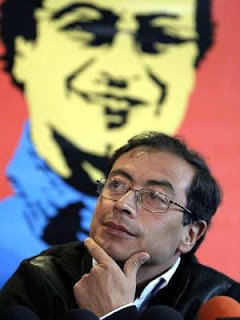
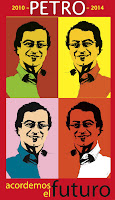
Sunday saw the dawn of a new left-wing in Colombia. Gustavo Petro, a former guerrilla in the ultra-left M-19 was elected Mayor of Bogota, in the process becoming the second most powerful politician in the land. The progressives - a political party he formed only four months ago - also became a major political force gaining councillor seats across the capital city. Petro wasted no time in announcing that this party would take their fight to the nation, promising to field candidates across the country when the country elects its congressmen and the president of the republic in 2014.

The left in Colombia has tended to the extreme rather than to the centre - more guerrilla and Chavez supporting  than ´third way´ pragmatists. Petro himself once played this role. But to get elected in Bogota he underwent a transformation, tidying up his image, softening his rhetoric and appealing to the middle-classes who once would have been appalled by his guerrilla past.

The election of Petro sends a message to those on the left that if they want to play a useful role in the political life of Colombia they must move to the centre. Will they heed it and will a new, democratic left become a major force in Colombian politics?

Wednesday, 2 November 2011

Mayor Gustavo Petro - the day that changed Colombian politics

Colombian politics has changed. For the first time in her history, a former guerrilla has become mayor of the capital city, Bogota. But Gustavo Petro, once a militant in the M-19 swept to power not by the bullet, but by the ballot box. Over 32% of Bogotanos voted for the left-wing radical, 8% more than the establishment choice, Enrique Penalosa.
 
It was unthinkable a few months ago, but Petro is now the second most powerful politician in Colombia.

How did Petro win, and what does it mean for Colombian politics?